

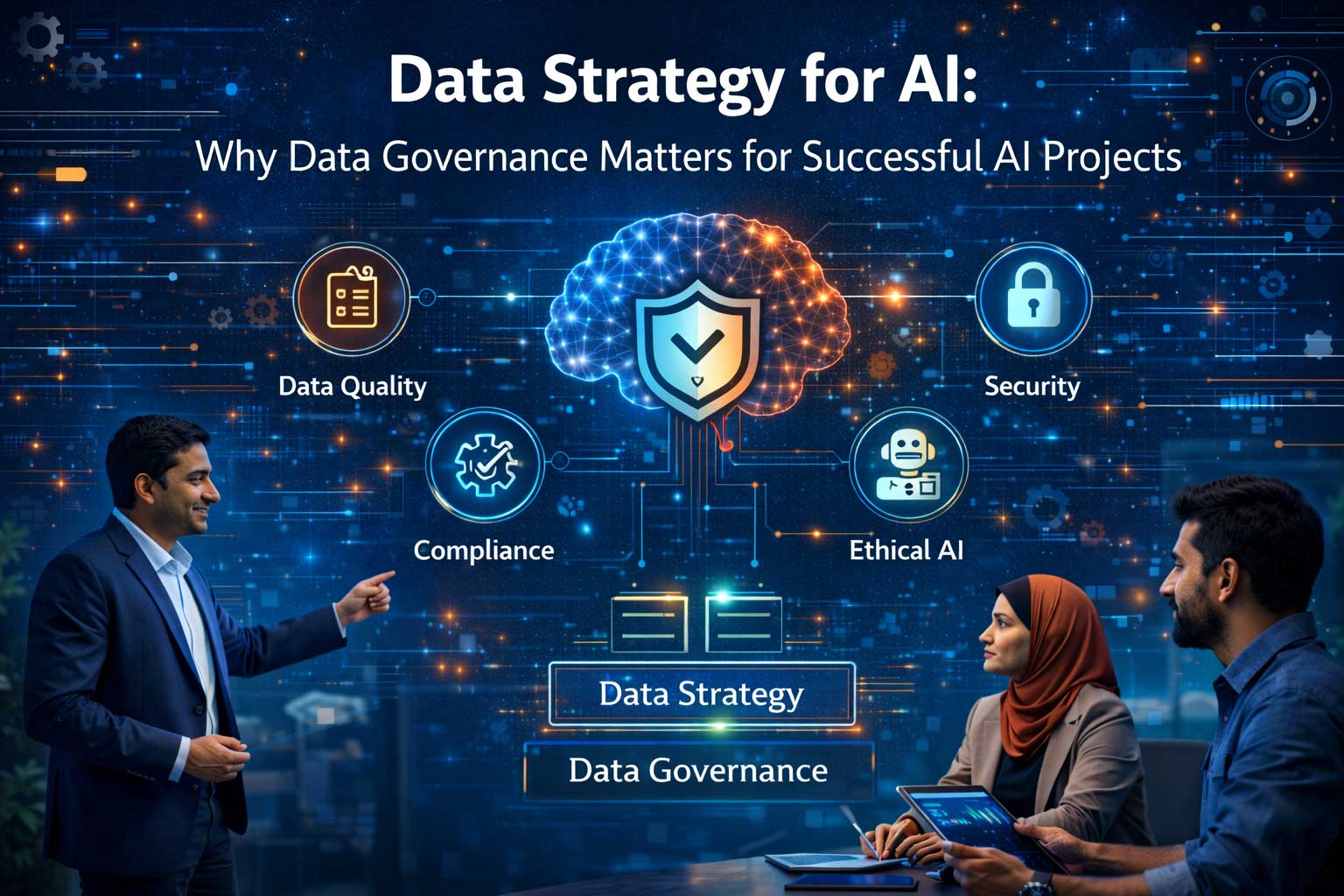

Artificial Intelligence is only as powerful as the data that fuels it. While many organizations invest heavily in AI technologies, machine learning models, and automation tools, the success of these initiatives ultimately depends on one critical factor: data quality and governance.
Without a strong data strategy, AI systems struggle to produce reliable results. Poor data quality, inconsistent data sources, lack of governance policies, and privacy concerns can significantly undermine the effectiveness of AI projects.
This is why organizations implementing AI must establish a robust data strategy supported by strong data governance frameworks.
In this guide, we will explore the role of data strategy in AI, why governance matters, and how businesses can build a data foundation that enables successful AI adoption.
What Is a Data Strategy for AI?
A data strategy for AI is a structured approach that defines how an organization collects, manages, stores, and uses data to support artificial intelligence systems.
AI models require large volumes of high-quality data to learn patterns and make accurate predictions. A data strategy ensures that this data is available, organized, secure, and compliant with regulations.
A strong data strategy typically focuses on several key elements:
- Data collection and integration
- Data quality management
- Data governance policies
- Data security and privacy
- Data storage and infrastructure
- Data accessibility for AI systems
When these elements are properly implemented, businesses can unlock the full potential of AI-driven insights and automation.
Why Data Governance Is Critical for AI Projects
Data governance refers to the policies, processes, and standards that ensure data is accurate, secure, consistent, and used responsibly across an organization.
AI projects rely heavily on large datasets. Without proper governance, organizations may face issues such as inaccurate predictions, biased models, regulatory violations, and security risks.
Below are some key reasons why data governance is essential for AI success.

Why Businesses Need an AI Roadmap
1. Ensures High Data Quality
AI models depend on accurate and well-structured data. If the data used to train models contains errors, duplicates, or inconsistencies, the AI system will produce unreliable results.
Data governance ensures that organizations maintain high standards for data accuracy, completeness, and consistency.
2. Improves AI Model Performance
Clean, well-organized datasets allow machine learning models to learn patterns more effectively.
Governance frameworks help standardize data formats, remove inconsistencies, and ensure datasets are suitable for AI training.
3. Supports Regulatory Compliance
Many industries must comply with strict regulations related to data privacy and security.
Examples include:
- GDPR (General Data Protection Regulation)
- HIPAA (Healthcare data protection)
- Financial data regulations
Data governance ensures organizations comply with these regulations while using data responsibly.
4. Prevents AI Bias and Ethical Issues
AI models trained on biased data may produce unfair or discriminatory outcomes.
Proper governance ensures that datasets are evaluated for bias and ethical risks before being used in AI systems.
5. Protects Sensitive Data
AI systems often process sensitive information such as customer records, financial transactions, and healthcare data.
Data governance policies help organizations implement security controls that protect this information.
Key Components of a Strong AI Data Strategy
To successfully implement AI projects, organizations must develop a comprehensive data strategy. Below are the core components.
Data Collection and Integration
Businesses collect data from many sources such as:
- Customer interactions
- Websites and mobile apps
- CRM and ERP systems
- IoT devices
- Social media platforms
A data strategy ensures that this information is integrated into a unified system.
Data Quality Management
Data quality management ensures that datasets used for AI training are accurate, consistent, and complete.
Common data quality practices include:
- Removing duplicate records
- Fixing missing values
- Standardizing data formats
- Validating data accuracy
Data Storage and Infrastructure
Organizations must design scalable data infrastructure capable of handling large datasets required for AI.
Common solutions include:
- Cloud data warehouses
- Data lakes
- Distributed storage systems
Data Security and Privacy
Protecting sensitive data is essential when developing AI systems.
Security measures may include:
- Encryption of data at rest and in transit
- Access control policies
- Identity management systems
- Secure APIs
Data Accessibility for AI Teams
AI teams must have access to relevant datasets to build models efficiently.
Data strategy should ensure that authorized teams can easily access the data they need while maintaining security controls.
Data Strategy vs Data Governance (Key Differences)
Many organizations confuse data strategy and data governance. While they are closely related, they serve different purposes.
| Aspect | Data Strategy | Data Governance |
|---|---|---|
| Definition | Overall plan for managing and using data | Policies and rules for data management |
| Focus | Data infrastructure and usage | Data quality, security, and compliance |
| Goal | Enable data-driven decision-making | Ensure responsible and controlled data usage |
| Scope | Technology, architecture, and analytics | Policies, processes, and accountability |
| Role in AI | Provides data foundation for AI models | Ensures reliable and ethical data use |
Both are essential for successful AI implementation.
Common Data Challenges in AI Projects
Organizations often face several challenges when building data-driven AI systems.
| Challenge | Impact on AI Projects |
|---|---|
| Poor data quality | Inaccurate AI predictions |
| Data silos across departments | Limited AI insights |
| Lack of governance policies | Compliance risks |
| Inconsistent data formats | Difficult model training |
| Limited data accessibility | Slower AI development |
Addressing these challenges early is critical to AI success.
Best Practices for Building an AI Data Strategy
Organizations can improve their AI success rate by following these best practices.
Establish Data Governance Policies
Define clear rules regarding how data is collected, stored, accessed, and used.
Build Scalable Data Infrastructure
Use cloud platforms and data lakes to support growing datasets.
Prioritize Data Quality
Implement automated data validation and cleaning processes.
Promote Data Literacy
Train employees to understand the importance of data governance and responsible data usage.
Monitor Data Continuously
Organizations should continuously monitor data quality and model performance to ensure AI systems remain reliable.
How AI Consulting Helps Build Data Strategies
Many organizations partner with AI consulting firms to design data strategies that support AI initiatives.
AI consultants help businesses:
- Assess existing data infrastructure
- Develop data governance frameworks
- Build scalable data architectures
- Integrate data sources across systems
- Prepare datasets for AI model training
With expert guidance, organizations can reduce risks and accelerate AI adoption.
The Future of Data Governance in AI
As AI technologies continue to evolve, data governance will become even more important.
Future trends include:
- Automated data governance systems
- AI-powered data quality monitoring
- Responsible AI frameworks
- Advanced data privacy technologies
- Real-time data compliance monitoring
Organizations that invest in strong data governance today will be better prepared for future AI innovation.
Final Thoughts
Artificial Intelligence has the potential to transform businesses across industries. However, the success of AI projects depends heavily on the quality, availability, and governance of data.
A strong data strategy ensures that organizations have the right infrastructure and processes to manage data effectively. Meanwhile, data governance ensures that data is accurate, secure, and used responsibly.
By combining both, businesses can build a solid foundation for successful AI adoption and long-term innovation.
Frequently Asked Questions (FAQs)
Data governance in AI refers to the policies, processes, and standards that ensure data used in artificial intelligence systems is accurate, secure, consistent, and compliant with regulations.
It helps organizations maintain control over how data is collected, stored, accessed, and used across AI projects.
Without proper governance, AI models may produce inaccurate or biased results. Governance frameworks also help businesses meet legal requirements related to data privacy and security.
Data quality directly affects the performance of AI models. Machine learning algorithms learn patterns from the data they are trained on. If the dataset contains errors, duplicates, or missing values, the AI system may generate incorrect predictions.
High-quality data ensures:
- Accurate AI predictions
- Better model performance
- Reduced bias in AI systems
- More reliable business insights
Organizations must implement data cleaning and validation processes to maintain high data quality.
A strong AI data strategy typically includes several key components:
- Data collection and integration from multiple sources
- Data storage infrastructure such as cloud data lakes
- Data quality management processes
- Data governance policies and compliance frameworks
- Data security and privacy controls
These elements work together to ensure that AI systems have access to reliable and secure datasets.
Without proper data governance, organizations may face several risks.
These include:
- AI models producing biased results
- Data breaches and security vulnerabilities
- Regulatory compliance violations
- Inconsistent data across systems
- Reduced trust in AI decision-making
Implementing governance frameworks helps mitigate these risks.
Businesses can improve their AI data strategy by focusing on several key initiatives.
These include:
- Creating clear data governance policies
- Building centralized data platforms
- Improving data quality and integration
- Investing in data security technologies
- Training teams on data management best practices
Working with experienced AI consultants can also help organizations develop scalable data strategies that support long-term AI adoption.