

Artificial Intelligence is transforming how businesses operate, compete, and innovate. Organizations are using AI to automate processes, analyze large datasets, improve customer experiences, and create smarter products and services.
However, adopting AI successfully requires more than simply integrating new tools. Many AI initiatives fail because companies jump directly into technology without a clear plan.
To achieve measurable results, businesses need a structured AI roadmap—a strategic framework that guides the entire journey from idea to implementation and scaling.
An AI roadmap helps organizations identify opportunities, evaluate readiness, prioritize use cases, and deploy AI solutions that align with business goals.
In this guide, we explore a step-by-step AI roadmap that businesses can follow to successfully implement artificial intelligence.
What Is an AI Roadmap?
An AI roadmap is a strategic plan that outlines how a business will adopt, implement, and scale artificial intelligence technologies to achieve its objectives.
It provides a clear path for organizations to move from AI exploration to full-scale deployment.
An effective AI roadmap typically includes:
• Business goals and AI vision
• AI readiness evaluation
• Identification of use cases
• Data and infrastructure planning
• Technology architecture
• AI development and deployment strategy
• Governance and compliance frameworks
• Continuous optimization
In simple terms, an AI roadmap answers the question:
How can we implement AI effectively to create business value?
Why Businesses Need an AI Roadmap
Many organizations experiment with AI but struggle to scale successful solutions. Without a roadmap, AI initiatives often face challenges such as poor data quality, lack of alignment with business goals, and inefficient resource allocation.
An AI roadmap helps businesses:
• Align AI initiatives with strategic objectives
• Prioritize high-impact AI projects
• Reduce implementation risks
• Allocate resources efficiently
• Ensure scalable AI adoption
Companies with a clear AI roadmap can transform AI from isolated experiments into a core capability that drives innovation and growth.
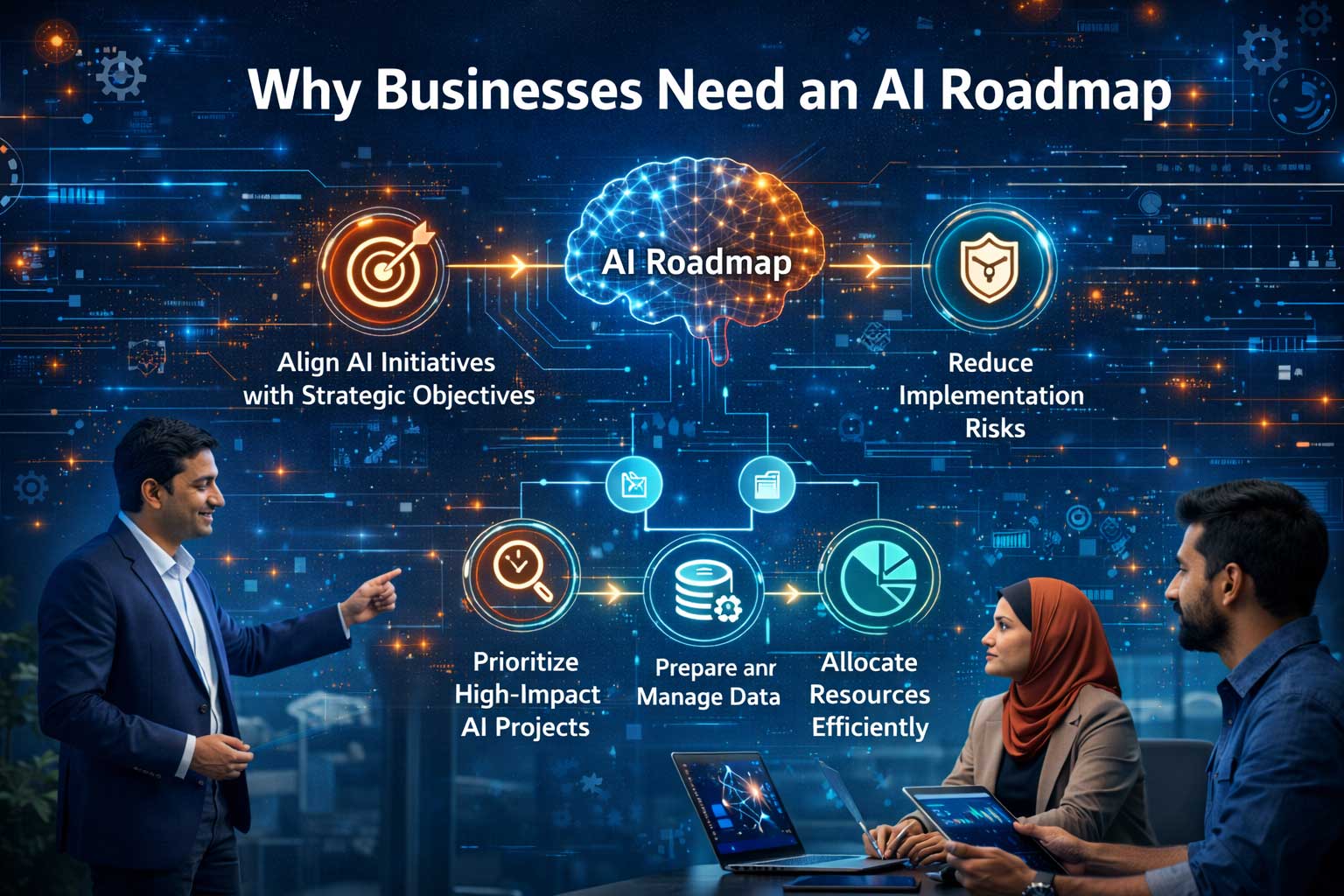
Why Businesses Need an AI Roadmap
Step 1: Define Business Goals and AI Vision
The first step in any AI initiative is defining why the organization wants to adopt AI.
Instead of focusing on technology, companies should start with business objectives.
Examples of AI goals include:
- Improving operational efficiency
- Reducing operational costs
- Enhancing customer experience
- Increasing revenue through data insights
- Automating repetitive tasks
A clear AI vision ensures that every AI initiative contributes to measurable business outcomes.
Step 2: Conduct an AI Readiness Assessment
Before implementing AI solutions, organizations must evaluate whether they have the necessary data, infrastructure, and skills.
An AI readiness assessment typically examines:
- Data availability and quality
- Technology infrastructure
- Cloud capabilities
- Data management systems
- AI talent and expertise
- Organizational readiness
This assessment helps identify gaps that must be addressed before launching AI projects.
Step 3: Identify High-Value AI Use Cases
Not every problem requires AI. Businesses should identify use cases where AI can deliver real value.
Common business AI use cases include:
- Customer support chatbots
- Sales forecasting
- Marketing personalization
- Fraud detection
- Supply chain optimization
- Predictive maintenance
Use cases should be prioritized based on:
- Business impact
- Data availability
- Implementation complexity
- Return on investment
Starting with high-impact projects increases the chances of successful AI adoption.
Step 4: Build a Strong Data Strategy
Data is the foundation of every AI system. Without high-quality data, AI models cannot deliver accurate results.
A strong AI data strategy should address:
- Data collection and storage
- Data cleaning and preparation
- Data governance policies
- Data privacy and compliance
- Integration of data across systems
Organizations must ensure that their data infrastructure supports AI development and scaling.
Step 5: Design AI Architecture and Technology Stack
AI implementation requires selecting the right technology environment.
Key components of AI architecture include:
- Cloud platforms (AWS, Azure, Google Cloud)
- Machine learning frameworks
- Data processing pipelines
- Model training environments
- APIs and AI services
- Monitoring and deployment systems
Choosing the right architecture ensures that AI systems are scalable, secure, and efficient.
Step 6: Develop and Test AI Models
Once the data infrastructure and architecture are in place, organizations can begin developing AI models.
The development process typically includes:
- Data preparation and labeling
- Model training using machine learning algorithms
- Model validation and testing
- Performance evaluation
This phase focuses on ensuring that AI models deliver accurate and reliable results before deployment.
Step 7: Deploy AI Solutions into Production
After successful testing, AI models are deployed into real-world environments.
Deployment may involve integrating AI systems into:
- Web applications
- Mobile apps
- Business workflows
- CRM and ERP systems
- Customer support platforms
Businesses should also implement monitoring systems to track model performance and detect potential issues.
Step 8: Scale AI Across the Organization
Once the first AI solutions prove successful, companies can scale AI across multiple departments and processes.
Examples of scaling AI include:
- Expanding AI automation across operations
- Deploying AI-driven analytics across departments
- Integrating AI into products and services
- Developing AI-powered customer experiences
Scaling ensures that AI becomes a core capability across the organization.
Step 9: Establish AI Governance and Compliance
As AI adoption increases, organizations must ensure responsible and ethical use of artificial intelligence.
AI governance includes:
- Data privacy compliance
- Ethical AI guidelines
- Bias detection and mitigation
- Security and risk management
- Transparency and accountability
Responsible AI practices help maintain trust and regulatory compliance.
Step 10: Continuously Optimize AI Systems
AI implementation is not a one-time project. AI systems require continuous improvement as new data becomes available.
Businesses should:
- Monitor model performance
- Update models with new data
- Improve algorithms and features
- Adapt to changing business requirements
Continuous optimization ensures long-term AI success.
Common Challenges in AI Implementation
Despite its potential, businesses often face challenges when implementing AI.
Some common obstacles include:
- Poor data quality
- Lack of AI expertise
- Integration with legacy systems
- Organizational resistance to change
- High initial investment
These challenges highlight the importance of having a structured AI roadmap and experienced AI consulting support.
How AI Consulting Helps Build an AI Roadmap
Many organizations partner with AI consulting firms to accelerate their AI transformation.
AI consultants help businesses:
- Conduct AI readiness assessments
- Identify valuable AI use cases
- Design AI architecture and infrastructure
- Develop AI implementation roadmaps
- Deploy and scale AI solutions
With expert guidance, companies can reduce risks and achieve faster results.
The Future of AI Roadmaps
As AI technologies evolve, future AI roadmaps will increasingly include:
- Generative AI applications
- AI-driven decision intelligence
- Autonomous business processes
- AI-powered product innovation
- Industry-specific AI platforms
Organizations that develop structured AI strategies today will be better positioned for the future.
Final Thoughts
Artificial Intelligence is transforming industries, but successful implementation requires careful planning.
A well-designed AI roadmap helps businesses move from experimentation to scalable AI adoption. By defining business goals, preparing data infrastructure, prioritizing use cases, and implementing AI responsibly, organizations can unlock the full potential of artificial intelligence.
Companies that adopt AI strategically today will gain a significant competitive advantage in the years ahead.
Frequently Asked Questions (FAQs)
An AI roadmap is a strategic plan that outlines how an organization will implement and scale artificial intelligence technologies.
It helps organizations align AI with business goals, prioritize use cases, and reduce implementation risks.
The first step is defining business goals and conducting an AI readiness assessment.
The timeline varies depending on the complexity of the project, but many AI initiatives take several months to implement.
Yes. Even small businesses benefit from a structured approach to AI adoption.
Industries such as healthcare, finance, retail, logistics, and manufacturing benefit significantly from AI.
Data is the foundation of AI systems. High-quality data is essential for training accurate models.
AI governance refers to policies and frameworks that ensure responsible and ethical AI usage.
Some organizations implement AI internally, but many work with AI consultants to reduce risks and accelerate implementation.
Common AI technologies include machine learning, deep learning, natural language processing, and computer vision.