

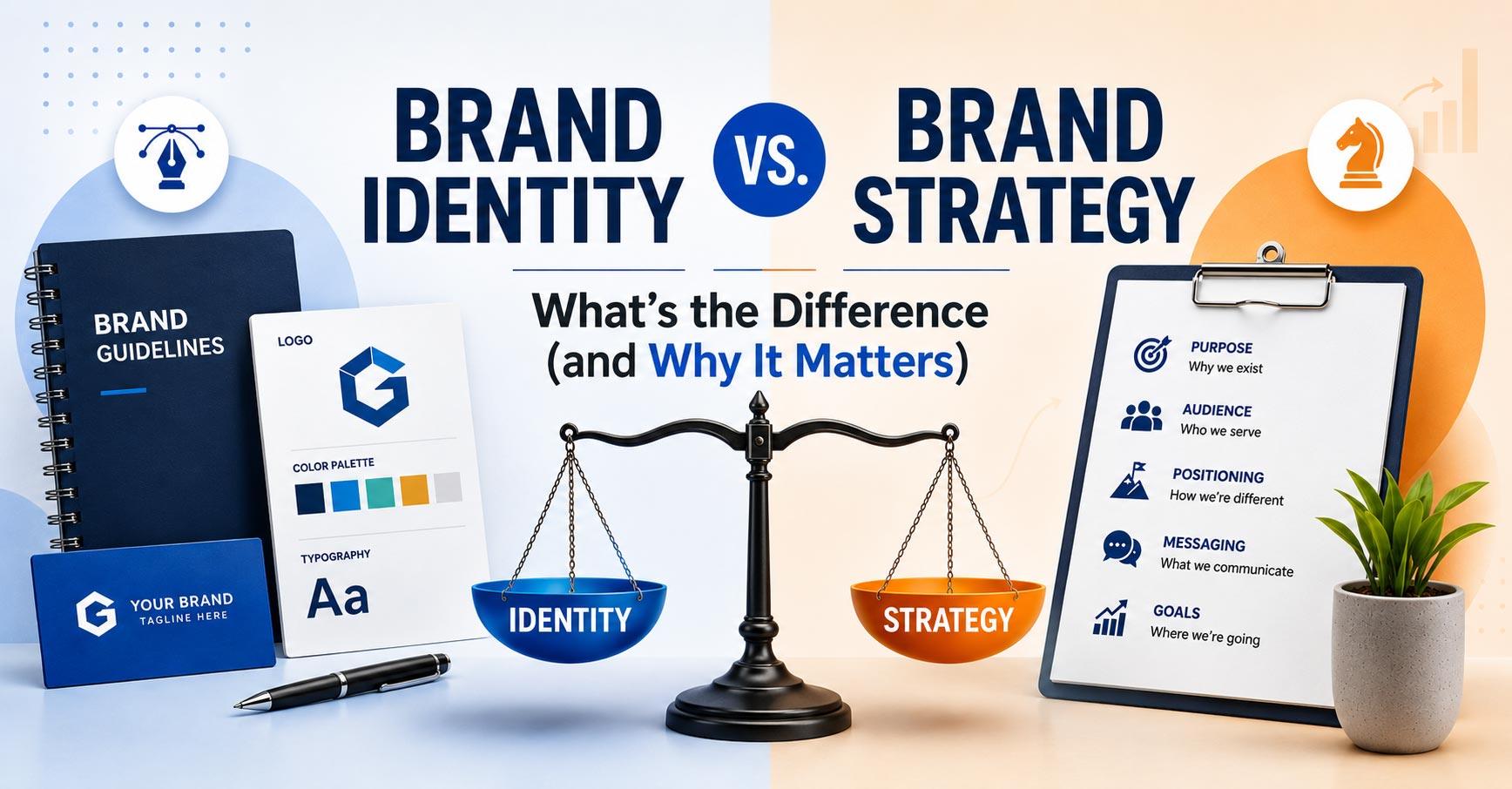

Many business owners believe that a professional logo is all they need to build a strong brand. Others think branding simply means choosing attractive colors or creating a modern website. While these elements are important, they are only one part of a much larger picture.
The truth is that brand identity and brand strategy are two different concepts, yet they work together to create a successful and memorable brand. Brand strategy defines your business direction, while brand identity visually communicates that direction to your audience. Without a clear strategy, even the most beautiful logo has little meaning. Likewise, a strong strategy without a consistent visual identity makes it difficult for customers to recognize and remember your business.
Understanding the difference between these two concepts helps businesses make smarter decisions about marketing, branding, customer experience, and long-term growth. Whether you’re launching a startup, rebranding an existing company, or expanding into new markets, knowing how brand identity and brand strategy work together can significantly improve your business success.
At M4YOURS IT, we help businesses create strategic brands that combine strong business planning with professional visual design. Our goal is not only to make brands look impressive but also to ensure they communicate the right message to the right audience at every stage of the customer journey.
In this comprehensive guide, you’ll learn:
- What brand strategy really means
- What brand identity includes
- The key differences between the two
- Why businesses need both
- Real-world examples
- Common misconceptions
- How to build a successful brand from the ground up
Let’s begin by understanding each concept individually.
What Is Brand Strategy?
Brand strategy is the long-term plan that defines how a business wants customers to perceive it. It serves as the blueprint behind every branding, marketing, communication, and customer experience decision.
Think of brand strategy as the brain of your brand. It determines why your business exists, who you serve, what makes you different, and how you want people to remember you.
Instead of focusing on visual design, brand strategy focuses on business objectives and customer perception.
A well-developed brand strategy answers questions such as:
- Why does our business exist?
- Who are our ideal customers?
- What problems do we solve?
- What makes us different from competitors?
- What value do we promise?
- How should customers describe our brand?
When these questions are clearly answered, every department from marketing and sales to customer support and product development can communicate consistently.
Key Components of Brand Strategy
A successful brand strategy is built on several important elements.
Brand Purpose
Your brand purpose explains why your business exists beyond making a profit.
Customers increasingly support companies that have a meaningful purpose. Businesses with a clear purpose often build stronger emotional connections and long-term customer loyalty.
Example:
A software company’s purpose may be:
“Helping small businesses simplify technology through affordable digital solutions.”
Brand Vision
Your vision describes where your business wants to be in the future.
It provides long-term direction and inspires employees, customers, and stakeholders.
Examples include:
- Becoming the most trusted IT solutions provider in Bangladesh.
- Transforming how businesses embrace digital innovation.
- Empowering organizations through smart technology.
Brand Mission
Your mission explains what your company does every day to achieve its vision.
Unlike vision, which focuses on the future, the mission focuses on present-day activities.
Example:
“Deliver innovative digital solutions that help businesses improve productivity and growth.”
Core Values
Core values define the principles that guide every business decision.
Common brand values include:
- Innovation
- Integrity
- Transparency
- Customer Success
- Excellence
- Accountability
- Collaboration
Strong values influence company culture and shape customer expectations.
Target Audience
Every successful brand knows exactly who it serves.
Instead of trying to appeal to everyone, effective brand strategies focus on a clearly defined audience.
A target audience profile often includes:
- Age
- Gender
- Industry
- Company size
- Location
- Budget
- Business goals
- Challenges
- Buying behavior
The better you understand your audience, the more relevant your branding becomes.
Brand Positioning
Brand positioning defines your unique place in the market.
It answers one important question:
Why should customers choose your business instead of your competitors?
Good positioning is based on:
- Customer needs
- Market opportunities
- Competitive advantages
- Unique expertise
Strong positioning helps businesses avoid competing solely on price.
Brand Messaging
Brand messaging is how you communicate your value to customers.
This includes:
- Headlines
- Website copy
- Sales presentations
- Advertising
- Social media content
- Email campaigns
- Customer communication
Good messaging is:
- Clear
- Consistent
- Customer-focused
- Easy to understand
- Memorable
Brand Voice
Your brand voice defines how your business sounds whenever it communicates.
Examples:
- Professional
- Friendly
- Innovative
- Premium
- Confident
- Educational
- Casual
A consistent voice helps customers recognize your brand even without seeing your logo.
Why Brand Strategy Matters
Many businesses invest thousands of dollars in logo design and marketing campaigns before creating a brand strategy.
This often leads to inconsistent messaging, confused customers, and wasted marketing budgets.
A clear strategy creates direction before any design work begins.
Businesses with a strong brand strategy typically benefit from:
- Better customer recognition
- Higher trust
- Consistent communication
- Improved marketing ROI
- Stronger competitive positioning
- Higher customer loyalty
- Easier business growth
Think of brand strategy as the foundation of a house. If the foundation is weak, everything built on top becomes unstable.
The same principle applies to branding.
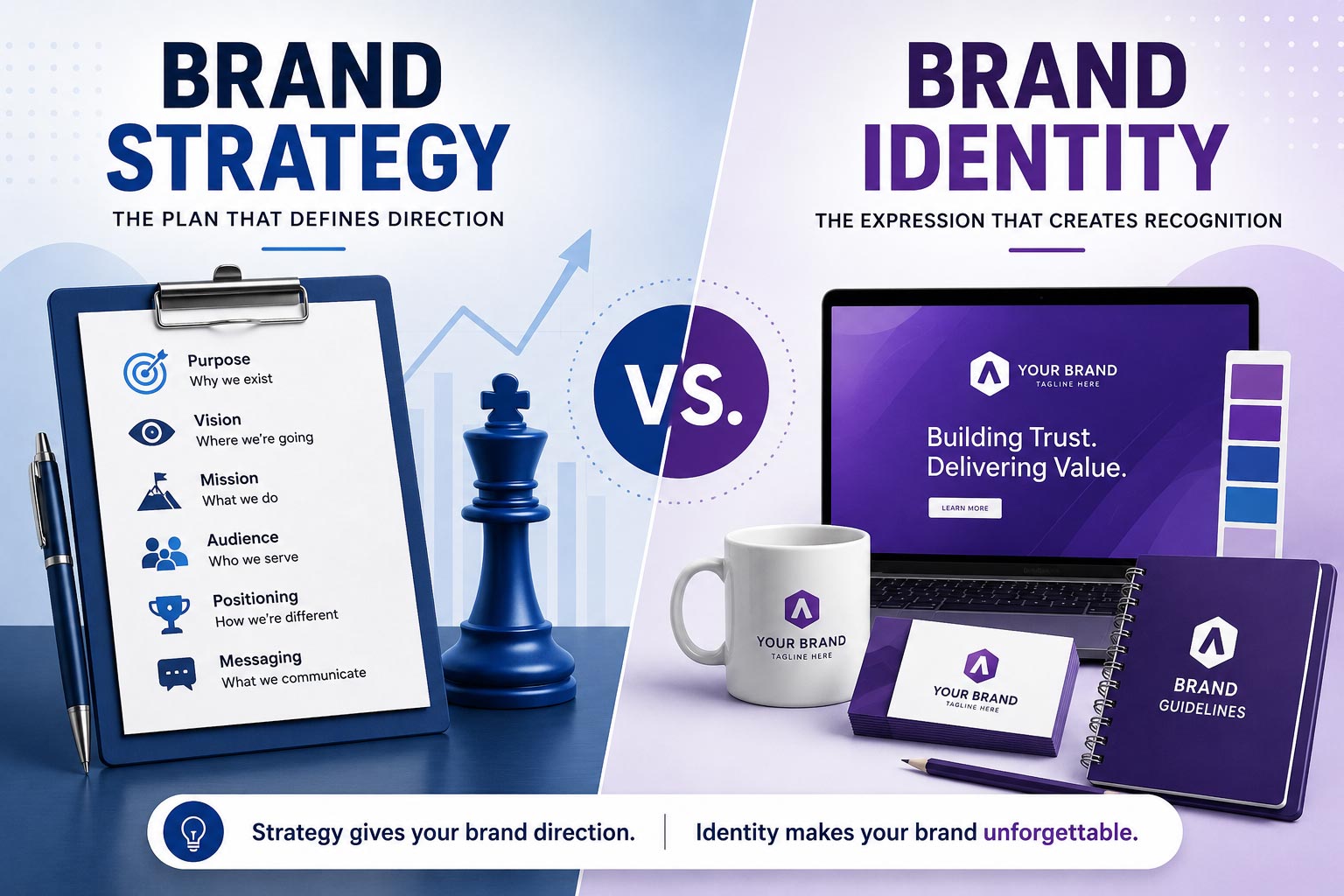
What Is Brand Identity?
Once your brand strategy is complete, the next step is transforming that strategy into something customers can see and recognize.
This is where brand identity comes in.
Brand identity is the collection of visual, verbal, and design elements that represent your business. It gives your brand a recognizable appearance and helps customers instantly identify your company across websites, social media, packaging, advertisements, and other touchpoints.
If brand strategy is the brain of your brand, brand identity is its face.
It communicates your personality, values, and positioning through design rather than words.
Customers often experience your brand identity before they ever interact with your products or services. A professional and consistent identity creates positive first impressions, builds familiarity, and reinforces trust over time.
Key Components of Brand Identity
Brand identity is made up of several visual and communication elements that work together to create a consistent brand experience.
Logo Design
Your logo is the most recognizable symbol of your business.
A great logo should be:
- Simple
- Memorable
- Timeless
- Scalable
- Versatile
It should work equally well on websites, business cards, mobile apps, social media, signage, and printed materials.
Color Palette
Colors play a major role in how customers perceive your business.
Different colors communicate different emotions.
For example:
Color | Common Brand Perception |
Blue | Trust, reliability, professionalism |
Green | Growth, sustainability, health |
Red | Energy, excitement, confidence |
Black | Luxury, sophistication |
Orange | Creativity, enthusiasm |
Purple | Innovation, imagination |
Choosing consistent brand colors improves recognition across every marketing channel.
Typography
Typography includes the fonts used across your branding.
Professional typography improves readability while reinforcing your brand personality.
For example:
- Modern sans-serif fonts create a clean, digital appearance.
- Serif fonts often communicate tradition and authority.
- Custom typography helps brands become more distinctive.
Brand Imagery
Brand imagery:
- Photography style
- Illustrations
- Icons
- Graphics
- Background elements
A consistent visual style makes your website, brochures, social media, and advertising feel unified.
Brand Guidelines
Brand guidelines document how your identity should be used.
These guidelines typically include:
- Logo usage rules
- Color codes
- Typography standards
- Icon styles
- Image guidelines
- Layout recommendations
- Tone of voice
- Spacing requirements
Without brand guidelines, different teams often create inconsistent marketing materials.
Corporate Identity Materials
Professional businesses extend their identity across multiple assets, including:
- Business cards
- Letterheads
- Email signatures
- Company profiles
- Presentation templates
- Proposal documents
- Social media graphics
- Office signage
- Marketing brochures
Consistency across these materials reinforces professionalism and credibility.
Why Brand Identity Matters
People recognize brands visually before they remember company names.
Think about how easily you can identify a business simply by seeing its colors, typography, or logo.
A consistent identity helps businesses:
- Build stronger recognition
- Improve customer trust
- Create memorable first impressions
- Support marketing campaigns
- Increase perceived professionalism
- Strengthen customer loyalty
Without a consistent identity, businesses often appear unorganized, making it harder for customers to remember or trust them.
Brand Strategy vs. Brand Identity: The Quick Comparison
Although these two concepts are closely connected, they serve very different purposes.
Brand Strategy | Brand Identity |
Defines long-term direction | Creates visual recognition |
Focuses on business goals | Focuses on design execution |
Determines customer perception | Shapes customer impressions |
Includes purpose, mission, positioning, and messaging | Includes logo, colors, typography, imagery, and design assets |
Guides every branding decision | Visually represents the strategy |
Usually created first | Developed after the strategy is defined |
One cannot effectively succeed without the other.
A strong strategy gives meaning to your identity, while a strong identity makes your strategy visible to the world.
Why Brand Identity and Brand Strategy Must Work Together
Many businesses think they only need a professional logo to build a successful brand. Others spend months developing a business strategy but neglect how their brand looks and feels. Both approaches create an incomplete brand.
Brand strategy and brand identity are not competitors—they are partners. One provides direction, while the other provides recognition. When they work together, they create a brand that customers understand, remember, and trust.
Imagine building a modern office.
- Brand strategy is the architectural blueprint.
- Brand identity is the completed building that people see.
Without a blueprint, the building lacks structure. Without the building, the blueprint remains only an idea.
The same principle applies to branding.
How Brand Strategy Influences Brand Identity
Every visual element should have a purpose.
For example, if your brand strategy positions your company as an innovative technology leader, your identity should support that perception through modern typography, clean layouts, minimal design, and contemporary color choices.
If your strategy focuses on trust and professionalism, your visual identity should communicate reliability rather than bold experimentation.
Brand strategy influences decisions such as:
- Logo style
- Brand colors
- Typography
- Photography
- Website design
- Marketing materials
- Social media appearance
- Presentation templates
Without strategy, these design decisions become personal opinions rather than business decisions.
Example
Imagine two cybersecurity companies.
Company A
Brand Strategy:
- Enterprise security
- Premium services
- Fortune 500 clients
- Highly technical expertise
Brand Identity:
- Dark blue color palette
- Minimal icon
- Professional typography
- Clean website
- Formal communication
Everything feels secure and trustworthy.
How Brand Identity Supports Brand Strategy
Once your strategy defines your business direction, brand identity communicates that strategy visually.
Customers don’t read your strategy document.
They experience your brand through:
- Website
- Social media
- Business cards
- Company profile
- Office environment
- Advertising
- Email signature
- Packaging
- Mobile application
Every interaction either strengthens or weakens your strategy.
For example:
If your strategy promises premium quality but your website looks outdated, customers immediately question your credibility.
Likewise, if your strategy focuses on innovation but your visual identity feels old-fashioned, your message loses impact.
Good design reinforces strategic positioning.
The Relationship Between Strategy and Identity
Think of the relationship like this:
Brand Strategy | Creates | Brand Identity Delivers |
Brand Purpose | Meaning | Visual expression |
Vision | Direction | Future-focused design |
Mission | Communication | Marketing materials |
Positioning | Differentiation | Unique appearance |
Values | Personality | Colors, imagery, typography |
Messaging | Customer communication | Consistent design language |
Neither side can perform effectively without the other.
Brand Identity vs. Brand Strategy vs. Brand Image
Many people also confuse brand image with brand identity and brand strategy.
Although the terms sound similar, they represent three completely different concepts.
Brand Strategy | Brand Identity | Brand Image |
What you want people to think | What customers see | What customers actually think |
Internal planning | Visual execution | Public perception |
Controlled by your business | Controlled by your business | Controlled by customers |
Long-term direction | Brand appearance | Customer experience |
Let’s understand each one.
Brand Strategy
Your internal business plan.
It defines:
- Why your company exists
- Who your audience is
- How you compete
- What makes you different
Customers rarely see this document directly.
Brand Identity
Everything customers can see.
Examples include:
- Logo
- Brand colors
- Typography
- Icons
- Website
- Social media
- Marketing materials
Identity communicates strategy visually.
Brand Image
Brand image exists entirely inside your customers’ minds.
It’s the reputation you’ve earned.
Customers develop their brand image based on:
- Product quality
- Customer service
- Marketing
- Reviews
- Word of mouth
- Online reputation
- Personal experience
You cannot directly control brand image.
You can only influence it through strategy and identity.
The Branding Process
Successful branding follows a logical sequence.
Many businesses skip steps, leading to inconsistent branding.
The recommended process is:
Step 1
Business Discovery
Understand the company, goals, competitors, and customers.
Step 2
Market Research
Study customer behavior and industry trends.
Step 3
Brand Strategy Development
Define:
- Purpose
- Mission
- Vision
- Positioning
- Audience
- Messaging
- Personality
Step 4
Brand Identity Design
Create:
- Logo
- Color palette
- Typography
- Icons
- Design system
Step 5
Brand Guidelines
Document standards for consistency.
Step 6
Marketing Implementation
Apply branding across:
- Website
- Social media
- Advertising
- Sales materials
- Presentations
Step 7
Customer Experience
Deliver the promises made by your brand.
Step 8
Continuous Improvement
Measure results and refine your branding over time.
Common Myths About Branding
Many businesses make branding decisions based on misconceptions.
Let’s clear up some of the most common myths.
Myth 1: Branding Is Just a Logo
Reality:
A logo is only one component of brand identity.
Branding includes:
- Strategy
- Messaging
- Customer experience
- Visual identity
- Reputation
- Communication
A beautiful logo cannot fix a weak business strategy.
Myth 2: Small Businesses Don’t Need Brand Strategy
Reality:
Small businesses often benefit the most from strategic branding.
Clear positioning helps them compete against larger competitors without relying solely on price.
Myth 3: Brand Identity Comes First
Reality:
Many companies hire designers before defining their positioning.
This usually results in attractive designs that fail to communicate a clear business message.
Strategy should always come before design.
Myth 4: Branding Ends After Launch
Reality:
Branding is an ongoing process.
As businesses grow, customer expectations, technology, and markets evolve.
Successful companies continuously refine their branding while maintaining consistency.
Myth 5: Branding Only Helps Marketing
Reality:
Branding influences almost every department.
Strong branding improves:
- Recruitment
- Customer support
- Sales
- Product development
- Partnerships
- Investor confidence
- Employee engagement
Signs Your Brand Strategy and Identity Are Misaligned
Businesses often notice problems long before they realize branding is the cause.
Watch for these warning signs:
- Customers don’t understand what you offer.
- Your logo looks modern, but your messaging feels outdated.
- Different marketing materials use different styles.
- Employees describe the company differently.
- Your website and social media don’t match.
- Customers confuse you with competitors.
- You compete mainly on price.
- Marketing campaigns produce inconsistent results.
These issues usually indicate that your strategy and identity are not working together.
Case Study: A Growing Technology Company
A growing IT company had invested in a modern logo and a new website. Despite the visual improvements, it struggled to attract enterprise clients.
After a branding audit, the company discovered several issues:
- Messaging focused on low-cost services rather than business outcomes.
- Visual identity appeared modern, but sales presentations looked inconsistent.
- Different departments used different value propositions.
- Marketing targeted multiple audiences without clear positioning.
The company rebuilt its brand strategy before redesigning its communication materials.
Within months, it experienced:
- Stronger brand consistency
- Improved lead quality
- Better customer trust
- Higher conversion rates during sales meetings
The logo changed very little—but the strategy behind it changed dramatically.
Core Components of Brand Strategy
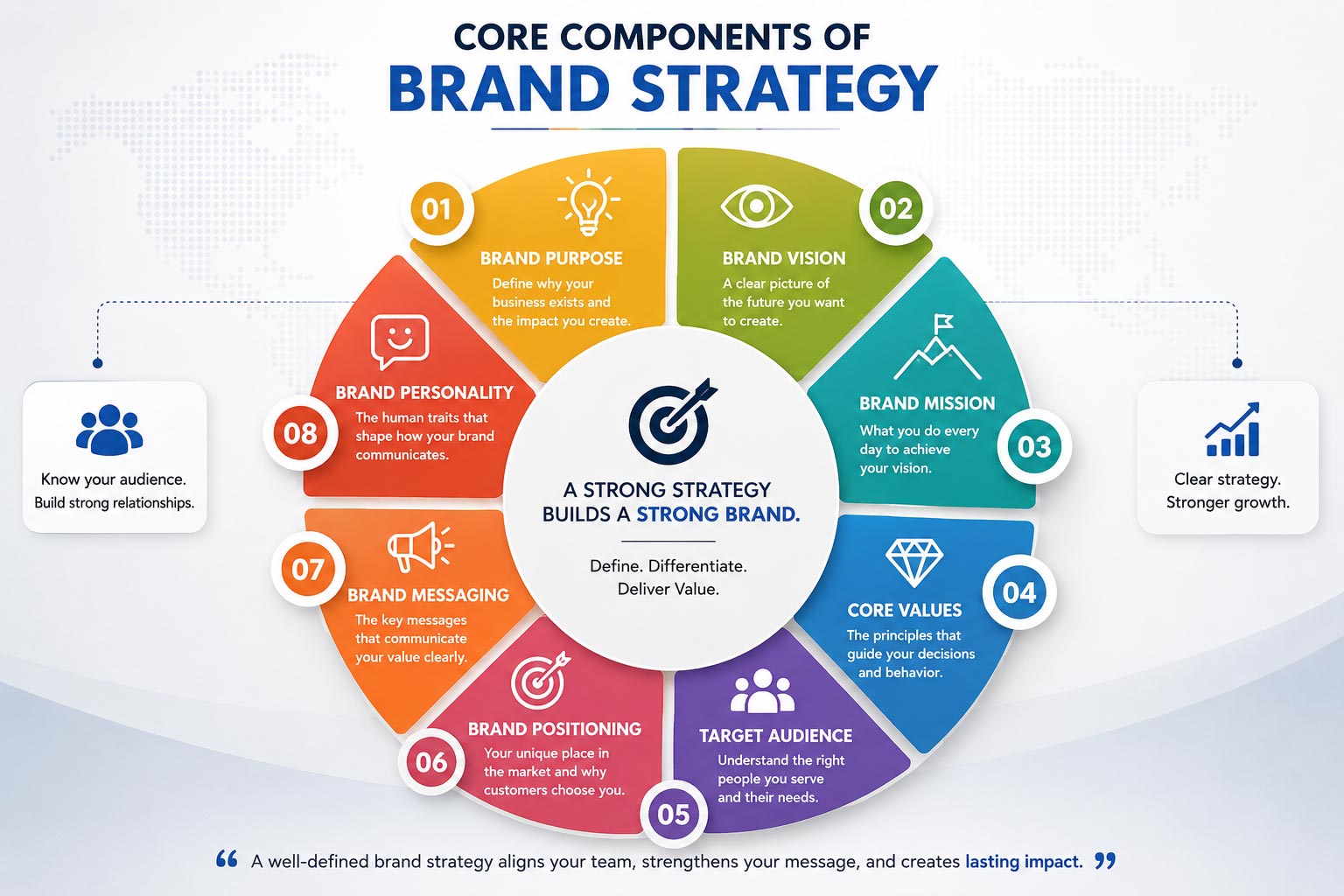
Building a successful brand starts with understanding its foundation. While every business is unique, the strongest brands all share a common strategic framework. These core components work together to define how a business communicates, competes, and grows.
Think of these components as the blueprint before construction begins. If one element is missing, the overall brand becomes less effective.
Let’s explore each component in detail.
1. Brand Purpose
Every successful brand has a reason for existing beyond making money.
Your brand purpose answers one simple question:
“Why does our business exist?”
A strong purpose inspires employees, attracts customers, and creates long-term business direction.
Companies with a meaningful purpose often build stronger emotional connections with their audience because customers increasingly prefer businesses that stand for something meaningful.
Example
Instead of saying:
“We build websites.”
A purpose-driven statement might say:
“We empower businesses to grow through innovative digital solutions.”
The second statement communicates impact rather than services.
Questions to Define Your Brand Purpose
Ask yourself:
- Why did we start this business?
- What problem are we solving?
- What positive impact do we want to create?
- Why should customers care about our company?
Your answers become the foundation of your branding strategy.
2. Brand Vision
Your vision describes the future you want to create.
It provides long-term direction for the entire organization.
Unlike goals, which can change over time, your vision should remain consistent for many years.
Examples
Technology Company
“To become the leading digital transformation partner for businesses worldwide.”
Healthcare Provider
“Creating healthier communities through accessible healthcare.”
Educational Institution
“Empowering lifelong learning for every generation.”
A strong vision motivates employees while giving customers confidence in your future.
3. Brand Mission
If your vision describes the destination, your mission explains the journey.
Your mission answers:
“What do we do every day to achieve our vision?”
Unlike vision statements, missions focus on current activities.
Example
Vision
“Become Bangladesh’s most trusted digital solutions provider.”
Mission
“Deliver innovative technology solutions with exceptional customer support and measurable business results.”
The mission guides daily business operations.
4. Core Values
Values represent the principles that influence every business decision.
They shape company culture, customer service, recruitment, leadership, and communication.
Without clearly defined values, businesses often become inconsistent.
Common Brand Values
- Integrity
- Innovation
- Excellence
- Transparency
- Customer Success
- Accountability
- Collaboration
- Sustainability
- Creativity
- Continuous Improvement
Choose values that genuinely reflect how your business operates—not just words that sound impressive.
5. Target Audience
One of the biggest branding mistakes is trying to serve everyone.
Successful brands understand exactly who they serve.
Instead of asking,
“How do we reach everyone?”
Ask,
“Who benefits most from our services?”
The more specific your audience, the stronger your messaging becomes.
Understanding Your Audience
Effective audience research includes:
Demographics
- Age
- Gender
- Income
- Education
- Occupation
- Business size
Geographic Information
- Country
- City
- Region
- Language
Psychographics
- Goals
- Values
- Interests
- Challenges
- Lifestyle
- Decision-making behavior
Business Information (B2B)
- Industry
- Company size
- Annual revenue
- Technology usage
- Business objectives
Understanding these details helps create more effective marketing campaigns.
Example Customer Persona
Category | Example |
Name | Sarah Ahmed |
Business | Marketing Agency |
Employees | 15 |
Goal | Generate more qualified leads |
Challenge | Outdated website |
Budget | Medium |
Needs | Branding, Website, SEO |
Decision Factor | Quality and reliability |
Creating personas makes branding more customer-focused.
6. Brand Positioning
Brand positioning defines your unique place in the market.
It answers one of the most important business questions:
Why should customers choose you instead of your competitors?
Good positioning creates differentiation.
Poor positioning creates confusion.
Strong Positioning Example
Instead of saying:
“We build websites.”
Say:
“We help growing businesses increase sales through high-performance websites designed for lead generation.”
Notice the difference.
The second statement focuses on outcomes rather than services.
Four Questions to Build Positioning
Ask:
- Who do we serve?
- What problems do we solve?
- How are we different?
- Why should customers trust us?
These answers become your positioning statement.
7. Brand Personality
Imagine your business as a person.
How would it behave?
Friendly?
Professional?
Bold?
Innovative?
Luxury?
Your personality influences everything from website copy to customer service.
Common Brand Personalities
Personality | Characteristics |
Professional | Reliable, knowledgeable, trustworthy |
Friendly | Warm, approachable, supportive |
Innovative | Creative, modern, forward-thinking |
Premium | Elegant, sophisticated, exclusive |
Bold | Confident, energetic, fearless |
Minimal | Simple, clean, focused |
Consistency builds familiarity.
Changing personalities frequently confuses customers.
8. Brand Messaging
Messaging is how your business communicates its value.
It includes:
- Website headlines
- Social media posts
- Advertising
- Sales presentations
- Email marketing
- Company profile
- Brochures
- Video scripts
Strong messaging focuses on customer benefits instead of company achievements.
Weak Messaging
“We’ve been in business for 15 years.”
Better Messaging
“Helping businesses grow faster through reliable technology solutions.”
The second message tells customers what’s in it for them.
Core Components of Brand Identity
Once strategy is complete, it’s time to give your business a recognizable appearance.
Brand identity transforms strategy into visual communication.
Every visual element should reinforce the strategic decisions made earlier.
1. Logo Design
A logo is often the first thing customers notice.
However, great logos are not simply attractive—they’re strategic.
An effective logo should be:
- Simple
- Memorable
- Versatile
- Timeless
- Scalable
It should look equally professional on:
- Websites
- Mobile apps
- Social media
- Business cards
- Company profiles
- Billboards
- Packaging
2. Color Palette
Colors communicate emotions before customers read a single word.
Choosing the right colors helps reinforce your positioning.
Color | Associated Meaning |
Blue | Trust, security, professionalism |
Green | Growth, sustainability, health |
Red | Energy, passion, confidence |
Orange | Creativity, enthusiasm |
Purple | Innovation, luxury |
Black | Premium quality, sophistication |
White | Simplicity, cleanliness |
The goal isn’t to follow trends but to choose colors that align with your strategy
3. Typography
Typography influences how people perceive your business.
Modern fonts create different impressions than traditional ones.
Examples include:
- Sans-serif fonts for technology companies
- Serif fonts for legal and financial brands
- Rounded fonts for friendly consumer brands
- Bold typography for sports and entertainment
Good typography improves both readability and recognition.
4. Photography Style
Professional brands use consistent imagery.
Examples include:
Technology companies
- Modern office environments
- Digital devices
- Team collaboration
Healthcare
- Caring professionals
- Clean environments
- Real patient interactions
Travel
- Destination photography
- Adventure experiences
- Authentic cultural moments
Consistency creates familiarity.
5. Graphic Elements
Brand identity extends beyond logos.
Supporting elements include:
- Icons
- Patterns
- Illustrations
- Buttons
- Background textures
- Infographics
These elements help create a recognizable visual system.
- Brand Guidelines
Brand guidelines ensure everyone uses your identity correctly.
Typical guidelines include:
- Logo usage
- Minimum spacing
- Approved colors
- Typography rules
- Photography standards
- Icon styles
- Tone of voice
- Social media templates
Without guidelines, different teams often create inconsistent marketing materials.
Brand Strategy vs. Brand Identity Components
Brand Strategy | Brand Identity |
Purpose | Logo |
Vision | Color Palette |
Mission | Typography |
Positioning | Photography |
Values | Graphic Elements |
Target Audience | Design System |
Messaging | Brand Guidelines |
Voice & Tone | Marketing Assets |
This table highlights how strategy defines the “why,” while identity delivers the “how.”
Startup vs. Small Business vs. Enterprise Branding
Not every business needs the same branding approach. The size, goals, and market position of a company influence how strategy and identity should be developed.
Business Type | Brand Strategy Focus | Brand Identity Focus |
Startup | Vision, positioning, audience validation | Logo, website, social media branding |
Small Business | Trust, local differentiation, consistency | Professional identity across all touchpoints |
Growing Company | Market expansion, brand messaging | Comprehensive brand system and guidelines |
Enterprise | Brand governance, customer experience, global consistency | Multi-channel identity management |
For example, a startup may only need a clear positioning statement and a professional logo, while an enterprise requires extensive brand governance, internal communication standards, and scalable design systems.
Step-by-Step Guide to Building a Brand Strategy
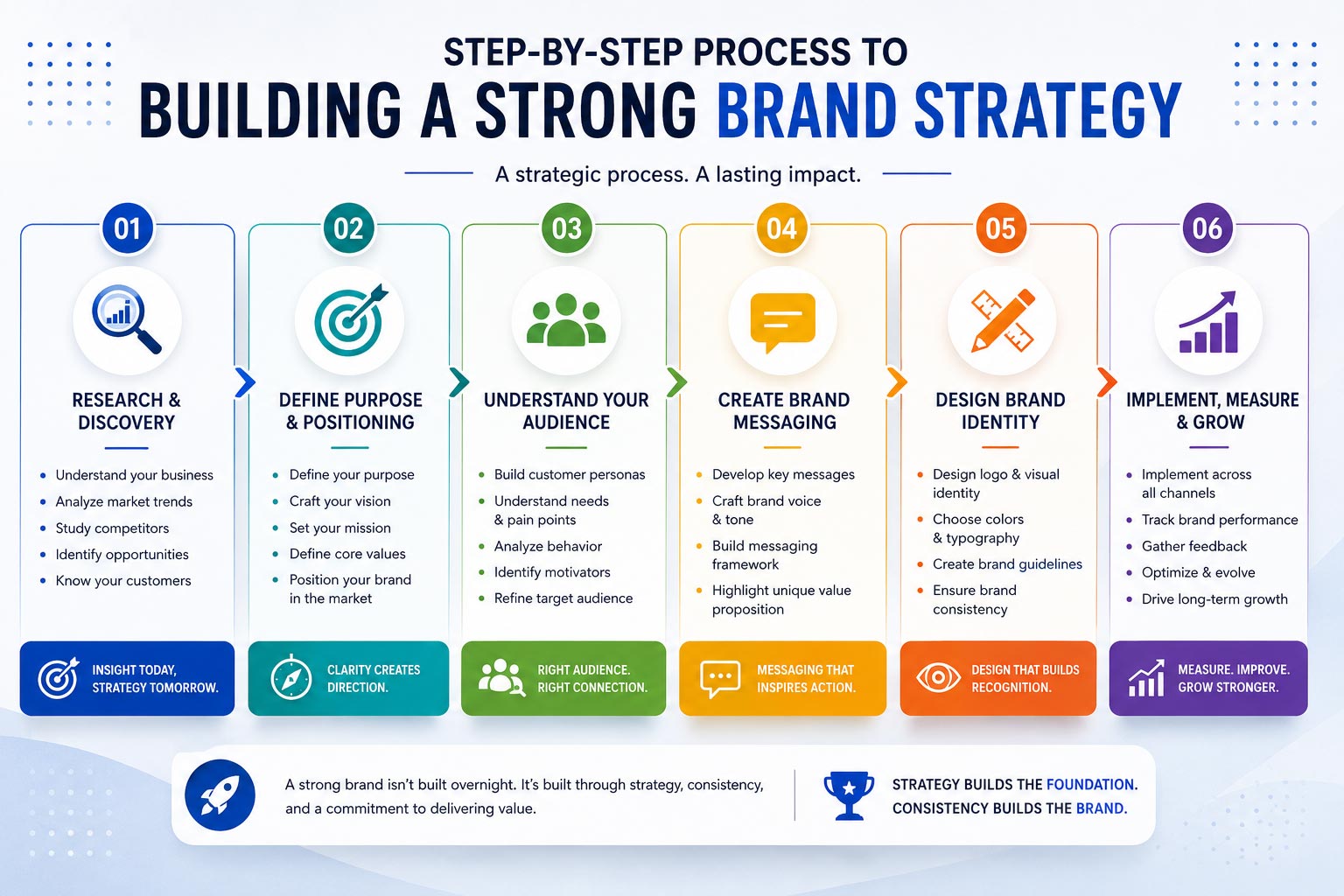
Creating a successful brand strategy doesn’t happen overnight. It requires research, planning, and a clear understanding of your business and customers.
Many companies rush into logo design or marketing campaigns without first defining their strategic direction. This often leads to inconsistent messaging, weak customer recognition, and unnecessary marketing expenses.
A structured brand strategy helps every future branding decision become easier and more effective.
Let’s walk through the process step by step.
Step 1: Understand Your Business
Every branding project begins with discovery.
Before designing anything, you need to understand your business from the inside out.
Ask yourself questions like:
- Why was this business created?
- What problems do we solve?
- What makes us different?
- What are our long-term goals?
- What values guide our decisions?
This stage creates clarity before moving into design.
Business Discovery Checklist
- Business goals
- Products and services
- Company history
- Competitive advantages
- Growth objectives
- Current challenges
A clear understanding of your business lays the foundation for every branding decision that follows.
Step 2: Research Your Market
Great brands don’t make assumptions—they rely on research.
Market research helps you understand your industry, competitors, and customer expectations.
Without research, your brand strategy is based on opinions instead of facts.
Areas to research include:
- Industry trends
- Customer behavior
- Competitor strengths
- Market gaps
- Emerging opportunities
The goal is to identify where your business can create unique value.
Competitor Analysis Example
Research Area | Questions to Ask |
Services | What do competitors offer? |
Pricing | How are they positioned? |
Branding | What visual style do they use? |
Messaging | What promises do they make? |
Website | What works well? |
Customer Reviews | What do customers like or dislike? |
Studying competitors isn’t about copying them it’s about finding opportunities to stand out.
Step 3: Define Your Target Audience
Successful branding speaks directly to the right audience.
Trying to appeal to everyone usually means connecting with no one.
Create detailed customer profiles that include:
- Industry
- Age
- Location
- Company size
- Budget
- Goals
- Pain points
- Buying habits
The more you understand your audience, the easier it becomes to create meaningful branding.
Audience Research Questions
Consider asking:
- What problems do customers face?
- What motivates their buying decisions?
- What are their biggest frustrations?
- Which social platforms do they use?
- What influences their purchasing decisions?
Answering these questions helps build stronger messaging.
Step 4: Develop Your Brand Positioning
Brand positioning defines how customers should think about your business compared to competitors.
Your positioning should clearly explain:
- Who you serve
- What you offer
- Why you’re different
- Why customers should trust you
Example
Weak Positioning
“We provide digital services.”
Strong Positioning
“We help growing businesses increase revenue through data-driven digital solutions and measurable results.”
Notice how the second statement focuses on customer outcomes rather than services.
Step 5: Create Your Brand Messaging
Messaging transforms strategy into communication.
Every business should develop consistent messaging for:
- Website
- Sales presentations
- Advertising
- Social media
- Company profile
- Email campaigns
- Customer support
Good messaging focuses on customer benefits instead of company achievements.
Messaging Framework
A complete messaging framework often includes:
- Brand promise
- Elevator pitch
- Value proposition
- Key benefits
- Tone of voice
- Call-to-action guidelines
When everyone uses the same messaging, customers receive a consistent experience.
Step 6: Document Your Brand Strategy
One of the biggest mistakes businesses make is keeping their strategy only in the owner’s mind.
Instead, create a documented brand strategy that everyone can follow.
Your document should include:
- Purpose
- Vision
- Mission
- Values
- Audience
- Positioning
- Messaging
- Brand personality
- Voice guidelines
A documented strategy becomes the reference point for future marketing and branding decisions.
Step-by-Step Guide to Building a Brand Identity
Once your strategy is complete, it’s time to design your brand identity.
Remember:
Design should always follow strategy—not the other way around.
Step 1: Design Your Logo
Your logo is the visual signature of your business.
It should reflect your strategic positioning while remaining simple and memorable.
A professional logo should work across:
- Websites
- Mobile apps
- Social media
- Business cards
- Billboards
- Packaging
- Merchandise
Avoid designing logos based only on current design trends.
Timeless logos usually outperform trendy ones.
Step 2: Select Brand Colors
Colors influence how customers feel about your business.
Choose colors that align with your brand personality.
For example:
Business Personality | Recommended Color Direction |
Professional | Blue, Gray |
Innovative | Purple, Blue |
Eco-Friendly | Green |
Luxury | Black, Gold |
Creative | Orange, Yellow |
Healthcare | Blue, Green, White |
Use a limited color palette to maintain consistency.
Step 3: Choose Typography
Fonts communicate personality just as much as colors.
Your typography should be:
- Easy to read
- Consistent
- Professional
- Appropriate for your audience
Most brands choose:
- One heading font
- One body font
Using too many fonts creates visual inconsistency.
Step 4: Build a Visual Design System
Brand identity extends beyond the logo.
Create consistent design elements such as:
- Icons
- Buttons
- Background patterns
- Illustrations
- Photography style
- Layout grids
- Graphic shapes
Together, these elements create a recognizable brand experience.
Step 5: Design Marketing Assets
Apply your identity consistently across every customer touchpoint.
Examples include:
- Business cards
- Letterheads
- Email signatures
- Company profiles
- Presentation templates
- Social media templates
- Website graphics
- Brochures
- Proposal documents
Customers should immediately recognize your brand regardless of where they encounter it.
Step 6: Create Brand Guidelines
Brand guidelines ensure consistency across your organization.
They explain how your visual identity should—and should not—be used.
Typical sections include:
- Logo usage
- Color specifications
- Typography
- Photography
- Iconography
- Social media design
- Document templates
- Tone of voice
These guidelines become essential as your team grows.
Common Branding Mistakes Businesses Make
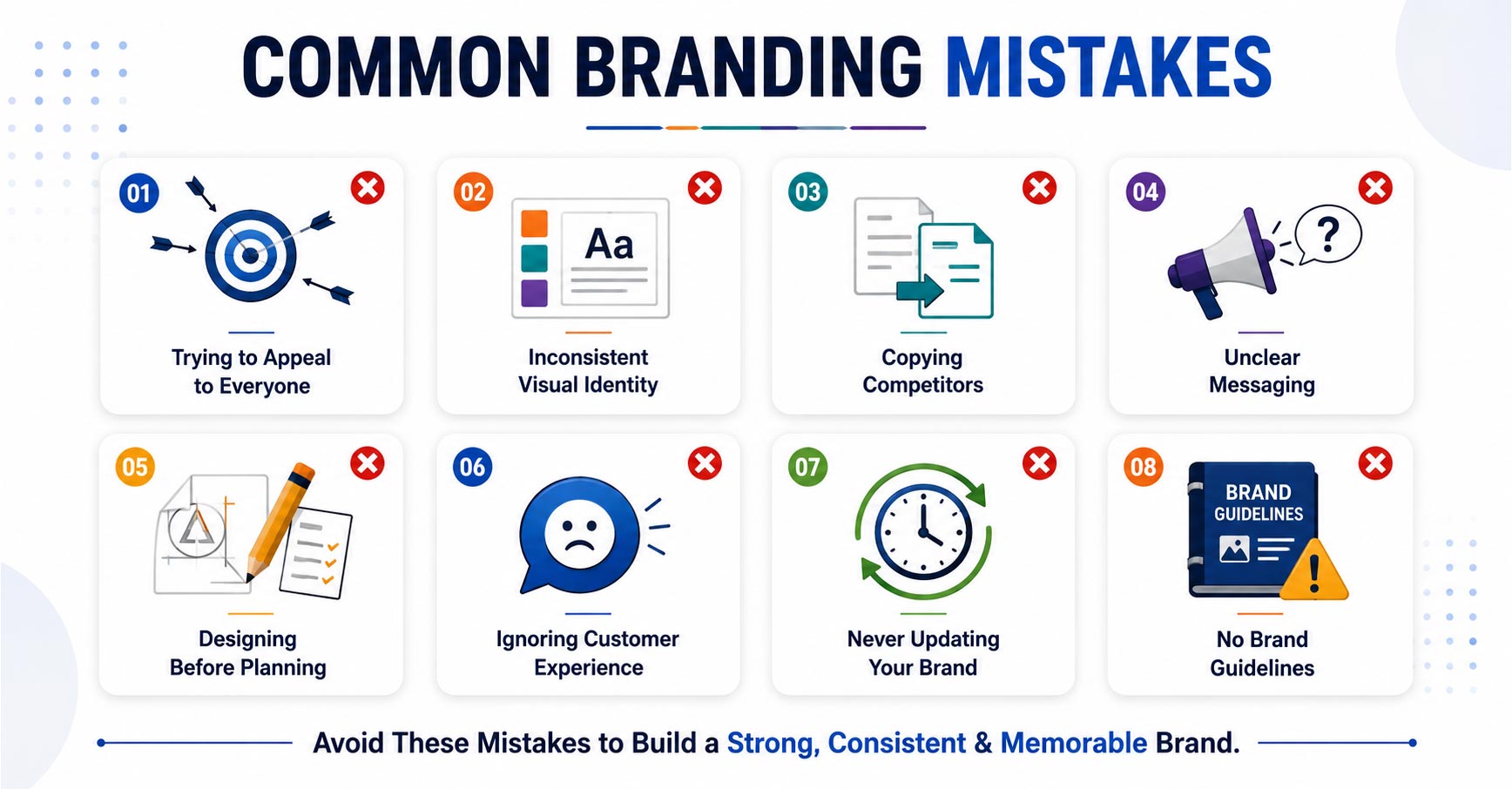
Even well-established businesses make branding mistakes that weaken customer trust and reduce marketing effectiveness.
Recognizing these issues early can save significant time and resources.
1. Designing Before Planning
Many businesses begin with logo design before defining their positioning or audience.
The result?
A visually appealing logo that doesn’t communicate a meaningful business message.
Always develop your strategy first.
2. Trying to Appeal to Everyone
When your messaging targets everyone, it usually resonates with no one.
Successful brands focus on specific audiences and solve specific problems.
Specificity creates stronger differentiation.
3. Inconsistent Visual Identity
Using different logos, fonts, colors, or layouts across platforms creates confusion.
Consistency builds recognition.
Every touchpoint should reinforce the same brand identity.
4. Copying Competitors
Inspired by competitors?
That’s fine.
Copying them?
That’s risky.
Customers remember brands that offer something unique.
Differentiate through your positioning, messaging, and customer experience.
5. Ignoring Customer Experience
Branding isn’t just what customers see.
It’s also what they experience.
Examples include:
- Customer support
- Delivery
- Product quality
- Website usability
- Communication speed
A premium-looking brand with poor customer service quickly loses credibility.
- Never Updating Your Brand
Businesses evolve.
Markets evolve.
Customer expectations evolve.
Your branding should evolve too.
Refreshing your brand doesn’t always mean redesigning your logo.
Sometimes updating messaging, photography, or marketing materials is enough.
Branding Best Practices
Successful brands consistently follow proven principles.
Here are some recommendations from the branding specialists at M4YOURS IT:
- Start with strategy before design.
- Keep your messaging simple and customer-focused.
- Maintain consistency across all channels.
- Build a memorable visual identity.
- Document your branding guidelines.
- Review your branding regularly.
- Train employees on brand standards.
- Focus on long-term recognition rather than short-term trends.
Small improvements made consistently often create stronger brands than frequent major redesigns.
Mini Case Study: From Inconsistent to Recognizable
A growing consulting firm had expanded rapidly over three years. However, its branding hadn’t kept pace with its growth.
Some teams used outdated logos, others created their own presentation templates, and marketing materials varied widely in style.
Customers frequently commented that the company’s communications felt inconsistent.
The business decided to invest in a complete brand strategy and identity review.
The project included:
- Audience research
- Brand positioning
- Updated messaging
- Refined visual identity
- Brand guidelines
- Standardized marketing templates
Within months, the company experienced:
- More consistent customer communication
- Increased confidence during sales presentations
- Stronger brand recognition
- Improved internal collaboration
- Higher-quality marketing materials
The transformation wasn’t driven by a new logo alone—it came from aligning strategy, identity, and execution.
How to Measure Brand Success
Building a strong brand is only the beginning. To know whether your brand strategy and brand identity are working, you need to measure their performance.
Many businesses invest in branding but never track the results. Without measurement, it’s difficult to know what’s working, what needs improvement, and whether your branding efforts are contributing to business growth.
Measuring brand success helps you make informed decisions, improve customer experiences, and maximize your marketing investment.
Let’s explore the key metrics every business should monitor.
1. Brand Awareness
Brand awareness measures how familiar people are with your business.
If potential customers don’t know your brand exists, they can’t choose your products or services.
Strong brand awareness often leads to increased website traffic, higher engagement, and more business opportunities.
Ways to Measure Brand Awareness
- Website traffic
- Search volume for your brand name
- Social media reach
- Brand mentions
- Direct website visits
- Media coverage
- Referral traffic
Growing awareness usually indicates that your branding and marketing efforts are reaching the right audience.
2. Brand Recognition
Brand recognition measures how easily customers identify your business through visual elements such as your logo, colors, typography, or marketing materials.
When people instantly recognize your company without reading your business name, you’ve built strong brand recognition.
Signs of Strong Brand Recognition
- Customers recognize your logo.
- Your brand colors are memorable.
- Marketing materials are instantly identifiable.
- Social media posts are easily associated with your business.
- Customers remember your company after seeing advertisements.
Consistency is the key to improving recognition.
3. Brand Trust
Trust is one of the most valuable assets a business can build.
Customers are more likely to buy from businesses they trust, recommend them to others, and remain loyal over time.
Brand trust develops through consistent experiences rather than advertising alone.
Indicators of Brand Trust
- Positive customer reviews
- High referral rates
- Repeat customers
- Testimonials
- Long-term client relationships
- Positive online reputation
Trust takes years to build but can be lost quickly if businesses fail to deliver on their promises.
4. Customer Loyalty
Loyal customers are often your strongest brand advocates.
Instead of constantly acquiring new customers, successful businesses focus on building lasting relationships with existing ones.
Customer Loyalty Metrics
- Customer retention rate
- Repeat purchases
- Subscription renewals
- Referral programs
- Customer lifetime value (CLV)
Businesses with strong branding usually enjoy higher customer retention and lower marketing costs.
5. Brand Perception
Brand perception reflects how customers feel about your business.
It answers questions like:
- Do customers see us as trustworthy?
- Are we viewed as innovative?
- Are we considered affordable or premium?
- What emotions do people associate with our brand?
Positive perception strengthens purchasing decisions and supports long-term growth.
Brand Metrics Every Business Should Track
Monitoring the right metrics helps evaluate whether your branding efforts are delivering meaningful business outcomes.
Metric | What It Measures | Why It Matters |
Brand Awareness | How many people know your brand | Increases market visibility |
Brand Recognition | Visual familiarity | Improves customer recall |
Website Traffic | Online visibility | Indicates marketing effectiveness |
Social Engagement | Audience interaction | Measures brand interest |
Customer Retention | Repeat business | Reflects loyalty |
Referral Rate | Word-of-mouth marketing | Shows customer satisfaction |
Lead Conversion Rate | Marketing performance | Connects branding to revenue |
Customer Reviews | Public reputation | Builds trust |
Review these metrics regularly to identify opportunities for improvement.
Tools to Measure Brand Performance
You don’t need expensive software to evaluate your brand.
Many affordable and free tools provide valuable insights.
Website Analytics
Use website analytics tools to monitor:
- Traffic sources
- Visitor behavior
- Bounce rates
- Popular pages
- Conversion rates
Social Media Analytics
Track:
- Followers
- Reach
- Engagement
- Shares
- Comments
- Video views
These insights help you understand how audiences interact with your brand.
Customer Surveys
Ask customers questions like:
- How did you hear about us?
- What words describe our brand?
- Why did you choose our business?
- Would you recommend us?
Customer feedback often reveals insights that analytics cannot.
Online Reviews
Review platforms provide valuable information about customer experiences.
Monitor reviews regularly and respond professionally to both positive and negative feedback.
Brand Identity and Strategy Trends in 2026
Branding continues to evolve as technology and customer expectations change.
Businesses that adapt to modern branding trends remain more competitive and relevant.
Here are some of the biggest trends shaping branding today.
1. Authentic Branding
Customers value honesty more than perfection.
Modern brands focus on transparency, genuine communication, and meaningful customer relationships.
Authenticity builds stronger emotional connections than polished marketing messages alone.
2. Human-Centered Design
Today’s brands prioritize customer experience over visual complexity.
Design decisions increasingly focus on:
- Accessibility
- Simplicity
- Usability
- Clear communication
Good branding makes information easier not harder to understand.
3. Consistency Across Every Platform
Customers interact with businesses through multiple channels.
Your branding should remain consistent across:
- Website
- Mobile applications
- Social media
- Email marketing
- Printed materials
- Sales presentations
- Customer support
A unified experience strengthens trust.
4. Purpose-Driven Branding
Customers increasingly support businesses with meaningful missions.
Brands that communicate clear values often build stronger communities and long-term customer loyalty.
Purpose should influence business decisions—not simply marketing campaigns.
5. AI-Assisted Branding
Artificial Intelligence is transforming branding workflows.
Businesses now use AI to assist with:
- Content creation
- Design inspiration
- Customer analysis
- Personalization
- Marketing automation
However, strategy, creativity, and human insight remain essential.
AI supports branding, it doesn’t replace strategic thinking.
Practical Branding Checklist
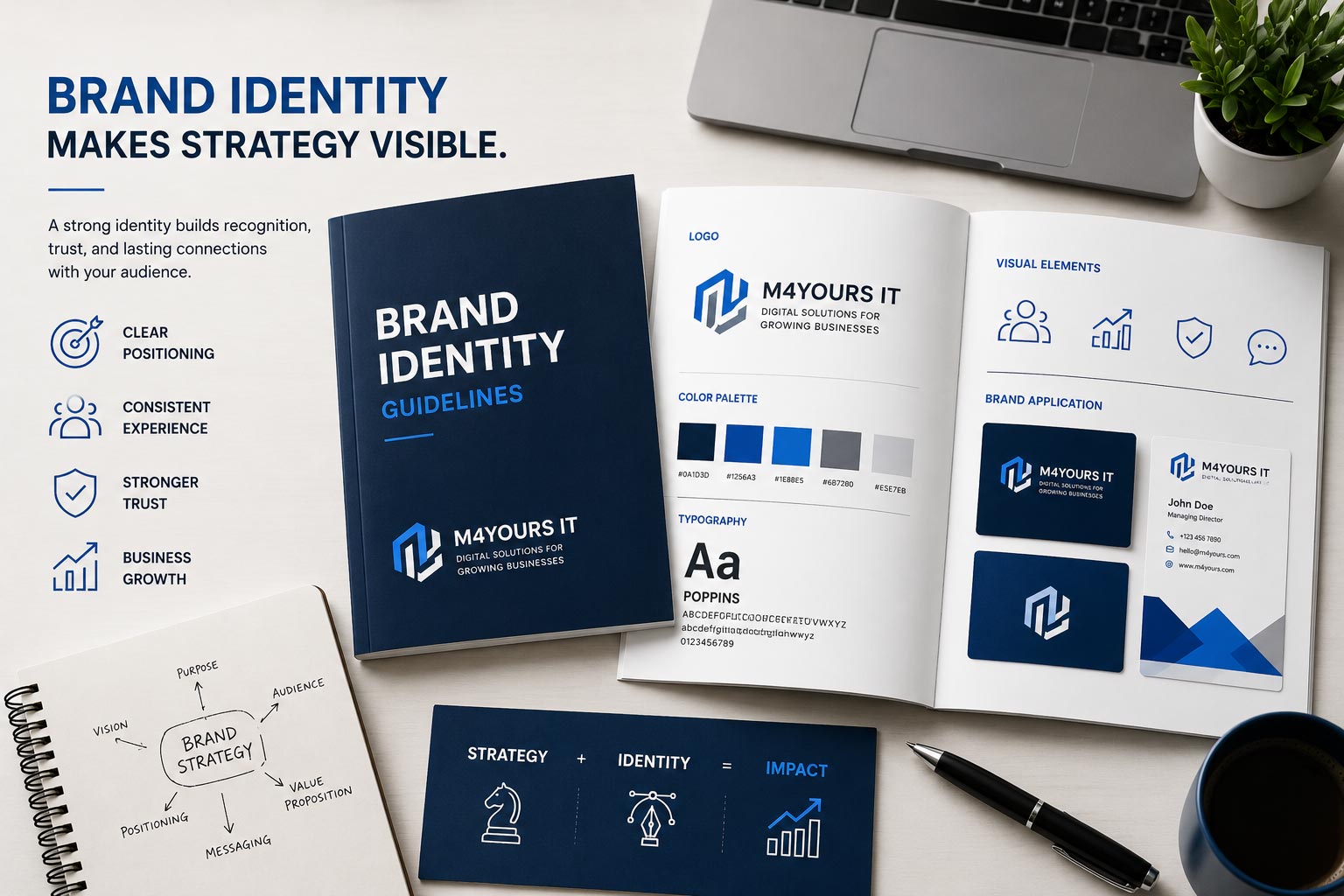
Whether you’re building a new brand or improving an existing one, this checklist can help keep your project on track.
Brand Strategy Checklist
- Clearly defined purpose
- Vision statement
- Mission statement
- Core values
- Target audience research
- Customer personas
- Brand positioning
- Value proposition
- Brand messaging
- Brand voice and tone
Brand Identity Checklist
- Professional logo
- Color palette
- Typography system
- Photography style
- Icon library
- Social media templates
- Business stationery
- Presentation templates
- Company profile
- Brand guidelines
Marketing Checklist
- Responsive website
- SEO-friendly content
- Consistent social media branding
- Email signature
- Sales materials
- Digital advertisements
- Printed marketing collateral
- Customer support templates
- Review management process
Completing these steps creates a stronger, more professional brand experience.
How M4YOURS IT Helps Businesses Build Strong Brands
At M4YOURS IT, we believe successful branding goes beyond attractive design.
We combine strategic thinking with creative execution to help businesses build brands that communicate clearly, earn customer trust, and support long-term growth.
Our branding services are designed to align every aspect of your business—from positioning and messaging to visual identity and digital experiences.
Our Brand Strategy Services
We help businesses develop clear strategic foundations through:
- Brand discovery workshops
- Business analysis
- Market and competitor research
- Customer persona development
- Brand positioning
- Mission and vision development
- Core value definition
- Brand messaging frameworks
- Brand voice guidelines
- Brand architecture planning
These services ensure every branding decision supports your business objectives.
Our Brand Identity Services
Our creative team develops professional identity systems that strengthen recognition and consistency.
Services include:
- Logo design
- Logo redesign and modernization
- Corporate identity design
- Brand guidelines
- Typography systems
- Color palette development
- Company profile design
- Social media branding kits
- Marketing collateral
- Motion branding
- Presentation templates
Every design element is created to reflect your strategy and communicate your brand consistently.
Why Businesses Choose M4YOURS IT
Organizations partner with us because we focus on measurable business outcomes—not just visual aesthetics.
What Sets Us Apart
- Strategy-first branding approach
- Experienced multidisciplinary team
- Custom branding solutions
- Scalable design systems
- Consistent brand implementation
- Digital-first thinking
- Business-focused creative process
- Ongoing consultation and support
Whether you’re launching a startup, modernizing an established brand, or expanding into new markets, we help create branding systems that grow with your business.
Expert Recommendations from M4YOURS IT
If you’re planning a branding project, consider these recommendations before investing in design or marketing.
For Startups
Focus first on:
- Brand strategy
- Audience research
- Positioning
- Professional logo
- Website branding
Avoid spending heavily on unnecessary design assets during the early stages.
For Small Businesses
Strengthen consistency by:
- Updating your visual identity
- Standardizing marketing materials
- Improving website messaging
- Creating brand guidelines
Consistency often creates a greater impact than frequent redesigns.
For Growing Companies
As your business expands:
- Review your positioning
- Refresh your messaging
- Improve internal brand consistency
- Standardize communication across departments
Growth should strengthen your brand does not dilute it.
For Enterprises
Large organizations should invest in:
- Brand governance
- Multi-channel consistency
- Employee brand training
- Comprehensive identity systems
- Ongoing brand performance measurement
Strong governance ensures every team communicates with one unified brand voice.