

Students rarely choose an education consultancy after seeing a single advertisement.
They search for study destinations, compare universities, check tuition fees, read scholarship information, watch videos, visit consultancy websites, review social media profiles, check Google reviews, ask friends or family, and often contact several agencies before deciding who they trust.
This makes education consultancy digital marketing very different from promoting a simple product.
An education consultancy must attract attention, establish credibility, answer important questions, capture enquiries, follow up with prospective students, and guide those leads toward counselling and application.
A successful digital marketing strategy therefore needs more than Facebook posts or occasional advertisements. It requires a connected system involving your website, SEO, Google Ads, social media, content, landing pages, lead tracking, reviews, remarketing, and follow-up.
This guide explains how education consultancies can build that system and generate more qualified student enquiries without depending on a single marketing channel.
What Is Education Consultancy Digital Marketing?
Education consultancy digital marketing is the use of online channels to attract prospective students, build trust, generate enquiries, and convert qualified prospects into counselling appointments and applications.
It can include:
- Search engine optimization
- Google Ads
- Facebook and Instagram advertising
- Social media marketing
- Educational content
- Video marketing
- Landing pages
- Google Business Profile optimization
- Email marketing
- WhatsApp follow-up
- Remarketing
- Online reputation management
- Analytics and conversion tracking
The objective should not simply be generating as many leads as possible.
A campaign that produces 1,000 enquiries but only a handful of eligible students may be less valuable than a campaign producing 150 well-qualified prospects.
Education consultancies should therefore focus on lead quality, counselling bookings, applications, enrolments, and cost per successful outcome, not only likes, clicks, impressions, or raw lead counts.
A structured digital marketing strategy can connect these different channels into one student-acquisition system rather than running disconnected campaigns. M4YOURS IT’s digital marketing approach similarly combines SEO, paid media, content, social media and analytics around measurable business outcomes.
Why Digital Marketing Matters for Education Consultancies
Student recruitment is highly competitive.
A prospective international student may encounter advertisements from universities, education consultancies, language schools, test-preparation companies, scholarship platforms, and competing agencies within the same week.
Simply being online is not enough.
Your consultancy needs to become visible at several stages of the student’s decision journey.
Someone searching:
“Study in Canada requirements”
is at a different stage from someone searching:
“education consultancy for Canada near me.”
Another student watching a video about studying in Finland may not yet be ready to speak with a counsellor.
Effective marketing recognizes these differences.
Your digital strategy should support students from initial awareness through:
Discovery → Research → Comparison → Enquiry → Counselling → Application
The closer your marketing is aligned with that journey, the more useful each channel becomes.
1. Start With Your Ideal Student Profile
Before launching campaigns, determine who you want to attract.
A consultancy offering ten study destinations can easily waste advertising budget by promoting everything to everyone.
Define student segments according to factors such as:
- Preferred study destination
- Undergraduate or postgraduate level
- Academic background
- English-language test status
- Approximate budget
- Intended intake
- Location
- Study interests
- Stage of decision-making
You may discover that different groups need entirely different campaigns.
For example, a student researching undergraduate opportunities in Malaysia should not automatically receive the same messaging as a postgraduate applicant considering Canada.
Segmentation makes advertising, content, landing pages, and counsellor follow-up more relevant.
2. Build a Website Designed for Student Enquiries
Your website should be more than an online company brochure.
It should help prospective students find information and take the next step.
Important sections may include:
- Study destinations
- Universities or institutions
- Courses and programs
- Admissions guidance
- Scholarship information
- Student eligibility information
- Counselling services
- Success stories
- Student testimonials
- Counsellor profiles
- FAQs
- Upcoming intakes
- Events or webinars
- Contact options
Every important page should provide a logical next action.
That might be:
- Book free counselling
- Check eligibility
- Request information
- Speak with a counsellor
- Send a WhatsApp message
An education-focused website should also be responsive, easy to navigate and fast enough for mobile visitors.
M4YOURS IT’s education website design service focuses on user journeys, structured information, scalable content and engagement-focused interfaces for education businesses.
3. Create Destination-Specific Landing Pages
Sending every advertisement to the homepage is usually a weak approach.
If someone clicks an advertisement about studying in South Korea, the destination page should continue that conversation.
A campaign landing page might contain:
- Clear destination headline
- Who the opportunity is suitable for
- Study levels
- Key application information
- Intake information
- Selected institutions or programs
- Counselling benefits
- Student trust signals
- FAQs
- Lead form
- WhatsApp or consultation CTA
The message between advertisement and landing page should feel connected.
M4YOURS IT’s landing page design approach similarly focuses on campaign-specific messaging, conversion-focused layouts and clear actions rather than treating every visitor the same.
4. Invest in SEO for Long-Term Student Acquisition
Paid advertising stops generating traffic when the budget stops.
SEO can help an education consultancy build a longer-term source of search visibility.
Potential keyword categories include:
Destination searches
- Study in Finland
- Study in Canada
- Study in Malaysia
Requirement searches
- IELTS requirement for studying abroad
- Study abroad with low GPA
- Master’s admission requirements
Program searches
- MBA abroad
- Computer science degree overseas
- Affordable bachelor’s programs abroad
Consultancy searches
- Education consultancy near me
- Study abroad consultancy
- Student consultancy in Dhaka
The best SEO strategy does not simply repeat keywords.
It creates useful pages that match real student questions.
Your SEO plan should include:
- Keyword research
- Technical SEO
- Destination pages
- Program pages
- Educational blogs
- Internal linking
- Local SEO
- Website performance
- Authority building
M4YOURS IT’s SEO services combine technical optimization, search-intent research, content and authority development to build sustainable organic visibility.

5. Use Google Ads to Capture High-Intent Demand
Social media is useful for generating awareness, but Google Search can reach students who are already actively looking for information or consultancy services.
Potential campaigns could target searches related to:
- Destination counselling
- Study abroad agencies
- University applications
- Specific intakes
- Specific programs
- Student consultations
Campaign structure matters.
Instead of putting dozens of destinations into one campaign, create focused groups with aligned keywords, advertisements and landing pages.
Google Ads also provides conversion tracking that can measure actions such as leads, calls and sign-ups, helping advertisers determine which campaigns and keywords contribute to meaningful outcomes.
For some eligible campaigns, Google also offers lead form assets that allow prospective customers to submit contact information directly through advertisements. Google currently supports lead form assets within Search and Performance Max campaigns, subject to eligibility and policy requirements.
The key is to optimize beyond clicks.
Track:
- Enquiries
- Qualified leads
- Counselling bookings
- Application starts
- Enrolments
6. Use Meta Advertising for Student Lead Generation
Facebook and Instagram can be powerful channels for education consultancies because students may discover opportunities before actively searching for them.
Campaign themes might include:
- Upcoming intakes
- Study destinations
- Scholarships
- University spotlights
- Eligibility assessments
- Education expos
- Webinars
- Free counselling
- Application deadlines
Meta currently offers lead-generation campaigns through forms, messaging and calling experiences, allowing service businesses to capture and qualify prospective customers through different conversion paths.
However, cheap leads should not be the objective.
A lead costing less is not necessarily more valuable.
Track the percentage of leads that become:
- Contactable
- Eligible
- Counselling appointments
- Applications
- Enrolments
This produces a much clearer picture of campaign quality.
M4YOURS IT’s paid social media advertising service similarly focuses on audience segmentation, creative testing, conversion tracking and ongoing campaign optimization.
7. Create Social Media Content That Answers Student Questions
An education consultancy’s social feed should not consist entirely of advertisements.
Students need information before they need sales messages.
Build several content pillars.
Destination Education
Explain:
- Why students choose the destination
- Education system
- Student lifestyle
- Study opportunities
Admission Guidance
Cover topics such as:
- Application preparation
- Academic requirements
- Intake planning
- Documentation
University and Program Content
Introduce institutions and available study areas.
Student Success Content
Show genuine student stories where permission has been obtained.
FAQ Content
Turn common counselling questions into:
- Posts
- Carousels
- Reels
- Videos
- Articles
Events and Counselling
Promote:
- Education fairs
- University visits
- Webinars
- Open days
- Free assessment sessions
Your objective is to make the consultancy’s social presence useful enough that students continue following it while making their study decision.
A structured social media marketing strategy can coordinate audience research, content planning, creative execution and campaign optimization across these channels.
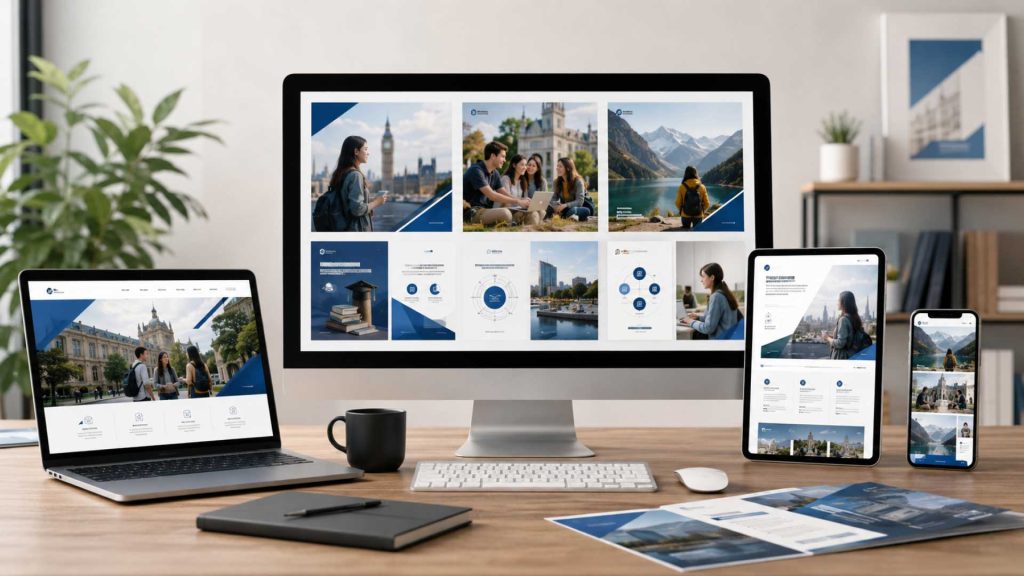
8. Build a Recognizable Social Media Design System
Education consultancy social content can quickly become visually inconsistent when campaigns cover many countries and universities.
Create a shared design system.
Define:
- Brand colours
- Typography
- Logo placement
- Country campaign structure
- Student photography style
- Icon style
- CTA treatment
- Carousel design
- Testimonial design
- Event design
- Video covers
Country-specific campaigns can still use destination imagery and flags, but the audience should recognize your consultancy before reading the company name.
Consistency builds familiarity.
9. Use Content Marketing to Capture Early-Stage Searches
Many students begin researching months before submitting an enquiry.
Useful blog topics might include:
- How to choose a study destination
- How university intakes work
- How to prepare for studying abroad
- Questions to ask an education consultant
- Comparing undergraduate and postgraduate options
- How to prepare for a counselling session
- What to consider when comparing universities
Content helps your consultancy attract students before competitors only targeting transactional keywords reach them.
It can also provide useful material for social posts, email campaigns and counsellor follow-up.
M4YOURS IT’s content marketing and copywriting services include SEO articles, website content, landing pages and campaign copy designed to support visibility and conversions.
10. Strengthen Local Search Visibility
Education consultancy decisions often include a local component.
Students and parents may search for a nearby office because they want an in-person consultation.
Your local strategy should include:
- Google Business Profile
- Correct contact information
- Accurate opening hours
- Office location
- Website link
- Appropriate business categories
- Genuine reviews
- Responses to reviews
- Location-specific website pages
Google states that reviews can help businesses stand out in Search and Maps and provide potential customers with useful information. Google also prohibits offering incentives in exchange for reviews.
Encourage genuine students or customers to share authentic experiences, but never manufacture reviews.
M4YOURS IT’s SEO services also include local SEO and Google Business Profile optimization for businesses seeking greater visibility in location-based searches.
11. Build Trust Before Asking Students to Apply
Education is a high-consideration decision.
Your marketing should demonstrate credibility.
Useful trust signals include:
- Real office information
- Professional counsellor profiles
- Genuine student testimonials
- Student success stories
- Real event photographs
- Transparent service information
- Clear contact information
- Useful educational content
- Recognizable business branding
- Privacy information
Avoid exaggerated claims such as guaranteed admission, guaranteed visas, guaranteed scholarships or unrealistic success rates unless there is legitimate, verifiable basis for the exact claim and it is permitted in the relevant jurisdiction and advertising platform.
Trust should come from evidence rather than hype.
12. Make WhatsApp and Messaging Part of the Funnel
Many students prefer messaging before committing to a consultation.
Your website and campaigns can provide direct communication options where appropriate.
But messaging works only when someone responds.
Establish:
- Response-time expectations
- Qualification questions
- Counsellor assignment
- Follow-up process
- Conversation status
- Appointment scheduling
Do not allow hundreds of advertising leads to disappear into individual employees’ phones without tracking.
13. Connect Leads to a CRM
As advertising volume grows, spreadsheets and inboxes become difficult to manage.
A CRM can help track:
New lead → Contacted → Qualified → Counselling booked → Application started → Application submitted → Enrolled
This allows management to answer much more important questions.
For example:
- Which campaign generates the most qualified students?
- Which destination produces the most applications?
- Which counsellor has the strongest follow-up rate?
- How quickly are leads contacted?
- Which channel produces enrolments rather than just leads?
Google’s current lead form documentation also supports integrations that can send lead information into CRM systems through supported methods.
14. Use Remarketing for Students Who Are Not Ready Yet
Not every website visitor will enquire during the first session.
That does not mean the visit was worthless.
Education decisions take time.
Remarketing campaigns can reconnect with people who previously interacted with your:
- Website
- Landing page
- Video
- Social profile
- Advertisement
Instead of repeating the same advertisement, show content appropriate to the next stage.
A student who viewed a destination page could later receive:
- Upcoming intake information
- University information
- Webinar invitation
- Counselling invitation
This creates continuity across the decision journey.
15. Measure the Metrics That Actually Matter
Vanity metrics can be useful for understanding reach, but they should not define business success.
Track the full funnel.
Awareness Metrics
- Reach
- Impressions
- Video views
- Engagement
Traffic Metrics
- Website visitors
- Landing page visitors
- Click-through rate
Lead Metrics
- Leads
- Cost per lead
- Qualified leads
- Cost per qualified lead
Counselling Metrics
- Appointments booked
- Appointment attendance rate
Application Metrics
- Applications started
- Applications submitted
Business Metrics
- Enrolments
- Cost per enrolment
- Revenue attributed to campaigns
A campaign with a higher cost per lead may be more profitable if those leads are more likely to become students.

A Practical Education Consultancy Digital Marketing Funnel
A simple structure may look like this:
Awareness
Social content, short videos, Meta advertising and educational content introduce the consultancy.
Research
Students visit destination pages, blogs, university information and testimonials.
Lead Generation
Google Ads, Meta campaigns, landing pages, eligibility forms and messaging capture enquiries.
Qualification
The consultancy checks destination interest, academic profile, intake, budget and readiness.
Counselling
Qualified students speak with a counsellor and discuss realistic options.
Application
Suitable students move into the formal application process.
Nurturing
Email, WhatsApp and remarketing help maintain communication when students are not ready immediately.
Measurement
CRM and analytics connect marketing activity with student outcomes.
This is much stronger than simply “boosting posts” every month.
Common Digital Marketing Mistakes Education Consultancies Make
Several recurring mistakes reduce marketing performance.
Advertising Every Country at Once
Too many messages create weak targeting.
Sending Traffic to the Homepage
Campaign-specific landing pages usually create a clearer journey.
Measuring Only Cost Per Lead
Lead quality matters more.
Ignoring Follow-Up Speed
Even good leads lose value when nobody contacts them.
Publishing Only Promotional Content
Educational content builds authority and trust.
Using Inconsistent Design
Fragmented branding weakens recognition.
Making Unverifiable Claims
Aggressive promises may damage credibility and create advertising or regulatory problems.
Ignoring SEO
Depending entirely on paid advertising creates long-term dependency on advertising budgets.
Failing to Track Applications and Enrolments
Marketing cannot improve if the team cannot connect leads with outcomes.
How M4YOURS IT Can Help Education Consultancies Grow
M4YOURS IT provides integrated digital solutions that can support education consultancies across the full marketing funnel.
Relevant services include:
- Digital marketing strategy
- Education website design
- Search engine optimization
- Local SEO
- Google Ads and paid media
- Social media advertising
- Social media marketing
- Content marketing
- Landing page design
- Creative design
- Conversion optimization
- Analytics and performance tracking
Rather than treating website development, content, advertising and lead generation as separate activities, an integrated approach connects them around measurable student-acquisition goals.
If your education consultancy wants to improve digital visibility, attract better student enquiries and build a scalable marketing system, contact M4YOURS IT to discuss a strategy tailored to your destinations, services and target markets.
Frequently Asked Questions
Education consultancy digital marketing uses channels such as SEO, Google Ads, social media, content, landing pages and email or messaging to attract prospective students and convert them into qualified enquiries.
There is no single best channel. Google Search can capture existing demand, while social media can create awareness and generate enquiries. SEO, content, reviews and remarketing support longer-term growth.
Yes. SEO can help consultancies appear for destination, program, admission and local consultancy searches when their website contains useful, well-structured content.
They can be effective when campaigns use relevant audiences, strong creative, suitable offers and proper lead qualification. Performance should be evaluated by qualified leads and enrolments rather than raw form submissions.
Google Ads can be particularly useful for reaching students actively searching for study destinations or consultancy services. Campaigns should use focused keywords, landing pages and conversion tracking.
Useful content includes destination guidance, university information, admission tips, student stories, FAQs, webinars, upcoming intakes, educational videos and counselling opportunities.
Landing pages create focused experiences for specific destinations or campaigns and provide visitors with a clearer path toward submitting an enquiry or booking counselling.
Use tighter targeting, clearer campaign messaging, qualification questions, relevant landing pages, strong follow-up processes and CRM tracking.
Track cost per lead, qualified lead rate, counselling bookings, appointment attendance, applications, enrolments and cost per enrolment in addition to traffic and engagement metrics.
Yes. M4YOURS IT provides digital marketing, SEO, paid advertising, social media marketing, education website design, content and landing page services that can support an integrated student-acquisition strategy.

