

Generating student enquiries is not usually the hardest part of digital marketing for an education or study abroad consultancy.
Generating the right student enquiries is.
A campaign may produce hundreds of form submissions, WhatsApp messages, or phone calls, but those numbers mean little if most prospects are unreachable, academically unsuitable, interested in destinations you do not support, outside the required budget range, or nowhere near ready to apply.
Effective student lead generation for consultants therefore needs to focus on more than lead volume.
The real objective is to create a predictable system that attracts prospective students, gives them useful information, identifies genuine interest, captures relevant details, assigns enquiries to counsellors, follows up consistently, and measures which leads eventually progress to counselling, application, and enrolment.
For education consultants, study abroad agencies, admissions counsellors, and student recruitment businesses, that requires a coordinated combination of website design, landing pages, SEO, Google Ads, social media, content, CRM systems, messaging, remarketing, and conversion tracking.
This guide explains how to build that system.
What Is Student Lead Generation?
Student lead generation is the process of attracting prospective students and converting their interest into identifiable enquiries that an education consultancy can qualify and follow up.
A lead could enter your system by:
- Completing a website form
- Booking a counselling appointment
- Requesting a callback
- Sending a WhatsApp message
- Responding to a social media campaign
- Completing a Meta lead form
- Calling your office
- Registering for an education event
- Attending a webinar
- Downloading a student guide
- Requesting an eligibility assessment
But not every lead has the same value.
A useful lead-generation strategy should eventually distinguish between:
New Lead → Contactable Lead → Qualified Student → Counselling → Application → Enrolment
That difference is important because marketing campaigns can look successful when judged by cost per lead while producing very little actual business.
Google Ads now explicitly supports qualified lead and converted lead goals, allowing advertisers to measure deeper stages of a lead journey rather than treating every initial form submission as equally valuable.
Why Education Consultants Need a Lead-Generation System
Student recruitment has a relatively long decision cycle.
Prospective students may spend weeks or months researching:
- Countries
- Universities
- Programs
- Tuition costs
- Admission requirements
- Scholarships
- Intakes
- Career opportunities
- Consultancy options
They may also speak with several consultants before choosing one.
A successful marketing system therefore needs to reach them at different moments.
One student may discover your consultancy through Instagram.
Another may search Google for a specific destination.
Another may read a blog post.
Someone else may receive a recommendation and visit your website directly.
The goal is to connect these channels so that interest can move toward a measurable outcome.
M4YOURS IT’s digital marketing services follow this integrated approach by connecting paid media, SEO, content, social media, analytics, and conversion strategy rather than treating each channel as a separate activity.
1. Define What a Qualified Student Lead Means
Before trying to generate more leads, define which leads your consultants actually want.
Your qualification criteria may include:
- Preferred destination
- Intended study level
- Academic profile
- English-language test status
- Approximate budget
- Preferred intake
- Current country or city
- Program interest
- Application timeline
- Readiness for counselling
Do not make the criteria unnecessarily restrictive.
The purpose is simply to distinguish potentially suitable students from enquiries your team cannot realistically serve.
For example, your CRM might categorize leads as:
New
No contact yet.
Contacted
Counsellor successfully reached the student.
Qualified
The profile reasonably matches available opportunities.
Counselling Booked
The student agreed to a counselling session.
Application Ready
The student is prepared to move to the next stage.
Once these definitions exist, your marketing team can optimize toward quality instead of simply chasing lower lead costs.
2. Segment Students Before Running Campaigns
One campaign should not try to speak to every possible student.
Segment prospects according to meaningful characteristics.
Destination
Create different campaigns for students interested in Canada, Finland, Malaysia, South Korea, the UK, or other markets you support.
Study Level
Undergraduate and postgraduate students often have different questions.
Intake
A student preparing for an upcoming intake requires different messaging from someone researching options for the following year.
Interest
You might segment campaigns around:
- Business
- Engineering
- Computer Science
- Healthcare
- Hospitality
- Other study areas
Decision Stage
A student researching “best countries to study abroad” is at a different stage from someone searching “study abroad consultant near me.”
Segmentation allows you to create more relevant:
- Advertising
- Landing pages
- Lead forms
- Content
- Follow-up messages
3. Build a Website Designed to Generate Student Leads
Your website should become the center of your lead-generation ecosystem.
Students arriving from search engines, social media, paid advertisements, referrals, or offline campaigns should immediately understand:
- What your consultancy does
- Which destinations you support
- Which services you provide
- Why they should trust you
- What they should do next
Important conversion elements may include:
- Book counselling
- Check eligibility
- Request a callback
- Speak with a counsellor
- WhatsApp contact
- Destination enquiry forms
Avoid hiding the main CTA only on the Contact page.
Place relevant conversion opportunities throughout:
- Homepage
- Destination pages
- University pages
- Program pages
- Blog articles
- Student success stories
A professional business website should be structured around enquiries and consultations rather than acting only as an online brochure. M4YOURS IT’s corporate website design approach similarly emphasizes conversion-focused layouts, structured content, lead-generation systems, and CRM integrations.
4. Create Campaign-Specific Landing Pages
Do not send every advertisement to the homepage.
If you are running a campaign for Study in Finland, create a Finland-focused landing page.
If your campaign promotes a student assessment, create an assessment landing page.
A high-converting student landing page may contain:
- Clear campaign headline
- Relevant destination or service
- Who the offer is for
- Key benefits
- Useful supporting information
- Genuine trust signals
- Student testimonial
- FAQ
- Short lead form
- Strong CTA
M4YOURS IT’s landing page design service is built around this principle: focused messaging, optimized forms, clear CTAs, responsive layouts, and a single campaign objective.
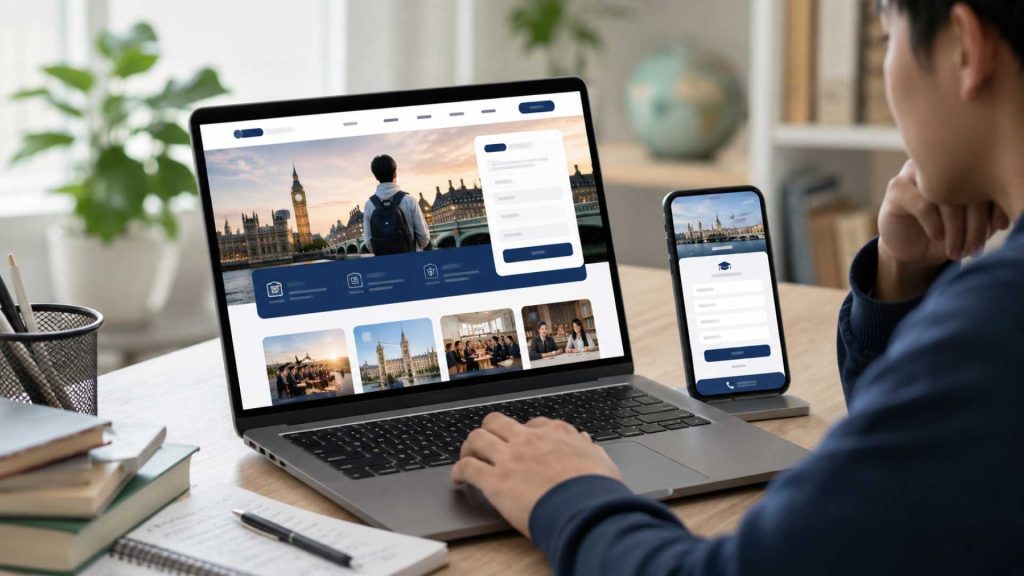
5. Keep Lead Forms Short but Useful
A form that asks for too little information may generate poor-quality leads.
A form that asks for too much may reduce submissions.
Find a practical balance.
For an initial education consultancy enquiry, fields might include:
- Name
- Phone
- Preferred destination
- Study level
- Intended intake
- English-test status
Additional academic and financial details can be collected during qualification if necessary.
For higher-intent campaigns such as detailed eligibility assessments, a longer form may make sense.
The form should match the visitor’s stage.
6. Use Google Ads to Capture Existing Student Demand
Google Search can be particularly valuable because it reaches prospects who are actively searching.
Possible keyword groups include:
- Study abroad consultant
- Education consultant
- Study in Canada consultancy
- Study in Finland consultant
- Overseas education agency
- Student consultancy near me
Create tightly focused campaign structures.
For example:
Campaign: Study in Finland
Ad Group 1: Finland education consultant
Ad Group 2: Study in Finland counselling
Ad Group 3: Finland university application
Each group should lead to a relevant landing experience.
Google Ads conversion tracking allows advertisers to measure meaningful actions such as leads, phone calls, and sign-ups, helping connect advertising activity with business outcomes.
Do not stop at measuring the initial enquiry.
Where your systems support it, feed later-stage outcomes such as qualified leads and successful conversions back into your reporting.
7. Use Meta Lead Campaigns for Student Discovery
Facebook and Instagram are useful when students may not yet be actively searching.
Campaign ideas include:
- Upcoming intake
- Destination awareness
- Free counselling
- Eligibility assessment
- Scholarship information
- Education fair
- Webinar
- University spotlight
Meta currently supports lead-generation campaigns through forms, messaging, and calling.
Its instant forms can reduce friction because students can submit information without navigating through a full website journey.
Meta also recommends CRM connectivity for faster lead retrieval and for sending later funnel outcomes back to advertising systems where appropriate.
This becomes especially useful when you want campaigns optimized toward students who actually progress rather than people who merely submit a form.
8. Create Better Social Media Advertising Creative
Targeting cannot rescue weak creative.
Students scroll quickly.
Your advertisement should communicate its main idea almost immediately.
Useful campaign themes might include:
- Study destination
- Upcoming intake
- Program category
- Free student assessment
- Education event
- Counselling opportunity
- University campaign
A good education ad creative should normally contain:
- Strong visual hierarchy
- Clear main message
- Recognizable consultancy branding
- Relevant student or destination imagery
- Simple CTA
Avoid placing excessive information inside one design.
If you have several important points, use a carousel or landing page instead.
M4YOURS IT’s paid media and advertising services combine audience segmentation, campaign planning, creative optimization, tracking, and continuous performance analysis to improve lead-generation efficiency.
9. Use Organic Social Media to Build Trust Before Conversion
Not every student will respond immediately to an advertisement.
Many will visit your profile first.
Your social media presence should therefore reinforce credibility.
Publish a mix of:
- Destination guides
- Student FAQs
- University information
- Counselling advice
- Student experiences
- Event photographs
- Videos
- Application preparation tips
- Team content
- Success stories
A student who sees only advertisements may view the page as promotional.
A student who sees consistent educational content may perceive the consultancy as a useful resource.
M4YOURS IT’s social media marketing service combines audience research, content planning, creative production, campaign execution, and analytics to support both visibility and conversion.
10. Use SEO to Generate Leads Without Paying for Every Click
SEO can build a long-term student acquisition channel.
Create useful pages around the topics students genuinely search.
For example:
Commercial Search
- Study abroad consultant
- Education consultancy
- Student consultancy
Destination Search
- Study in Canada
- Study in Finland
- Study in Malaysia
Program Search
- Study computer science abroad
- International business programs
Informational Search
- How to choose a study abroad destination
- How to prepare for university applications
- Questions to ask a study abroad consultant
Every informational article should provide a logical next step.
For example:
Read guide → Explore destination → Check eligibility → Book counselling
This converts content marketing into a lead-generation pathway.

11. Make WhatsApp Part of the Lead System
For many consultancies, messaging is an important communication channel.
But simply placing a WhatsApp button on the website is not enough.
Define what happens after the student sends the first message.
You might collect:
- Preferred destination
- Study level
- Intake
- Test status
- Current qualification
Then assign the enquiry to a counsellor.
Meta’s lead-generation guidance similarly recommends using qualifying questions and giving prospects clear expectations about what happens after they submit their information.
Keep qualification conversational.
Do not turn the first interaction into a 25-question interrogation.
12. Connect Every Lead to a CRM
As lead volume increases, manual spreadsheets become difficult to control.
A CRM can centralize:
- Contact information
- Lead source
- Campaign
- Destination
- Counsellor
- Follow-up history
- Qualification
- Counselling appointments
- Application status
A useful pipeline might be:
New Lead → Contacted → Qualified → Counselling Booked → Application Started → Submitted → Enrolled
M4YOURS IT provides custom CRM development for businesses that need lead pipelines, customer interaction tracking, workflow automation, dashboards, and integrated operational systems.
The important point is not which CRM you choose.
It is ensuring every lead enters a system where somebody is responsible for the next action.
13. Improve Lead Response Speed
Marketing does not end when the form is submitted.
A student lead can lose interest quickly.
Your process should define:
- Who receives new leads
- How counsellors are notified
- What happens when the student does not answer
- How many follow-ups are appropriate
- Which channels are used
- When a lead becomes inactive
Automation can help with:
- Assignment
- Notifications
- Appointment reminders
- Follow-up tasks
But student counselling should still feel human.
Automation should support the counsellor rather than replace meaningful conversations.
14. Nurture Students Who Are Not Ready
Many legitimate leads are not ready to apply immediately.
Do not treat them as failed leads.
Create nurturing sequences based on interest.
A student interested in Finland might receive:
- Destination guide
- Upcoming intake information
- Relevant program content
- Webinar invitation
- Counselling reminder
Another student researching options for next year may receive less frequent educational content.
Lead nurturing keeps your consultancy visible while the student continues researching.
15. Use Remarketing to Reconnect With Interested Students
Prospects may:
- Visit a destination page
- Watch a video
- Open an advertisement
- Visit an eligibility page
- Read several articles
without submitting an enquiry.
Remarketing can bring some of these visitors back.
Possible remarketing messages include:
- Book free counselling
- Explore the next intake
- Attend a webinar
- Complete your assessment
- Learn more about the destination
M4YOURS IT’s paid media offering includes remarketing and retargeting campaigns designed to re-engage audiences who have already interacted with a brand.
16. Build Trust Into Every Lead-Generation Touchpoint
Students and families are making significant education decisions.
Your marketing should provide evidence that your consultancy is legitimate and professional.
Useful trust signals include:
- Professional website
- Real office information
- Counsellor profiles
- Genuine reviews
- Real student testimonials
- Student success stories
- Event photographs
- Clear business information
- Privacy policy
- Consistent branding
Avoid unverifiable claims.
Statements such as guaranteed admission, guaranteed scholarships, guaranteed visas, or guaranteed future outcomes can damage credibility and may create compliance problems.
17. Optimize for Qualified Leads, Not Cheap Leads
Suppose:
Campaign A
- 400 leads
- Low cost per lead
- 15 qualified students
Campaign B
- 150 leads
- Higher cost per lead
- 55 qualified students
Campaign B may be dramatically more valuable.
Track metrics such as:
- Cost per lead
- Contact rate
- Qualified lead rate
- Cost per qualified lead
- Counselling booking rate
- Counselling attendance
- Application rate
- Enrolment rate
Google’s current lead measurement system specifically distinguishes initial leads from qualified and converted leads, reflecting the importance of evaluating deeper funnel outcomes.
18. Continuously Improve Landing Page Conversion
You do not always need more traffic.
Sometimes you need to convert existing traffic more effectively.
Review:
- Headline clarity
- CTA wording
- Form length
- Mobile usability
- Trust signals
- Page speed
- Content hierarchy
- Destination relevance
Conversion Rate Optimization uses data and testing to identify friction and improve how many visitors take meaningful actions.
M4YOURS IT’s Conversion Rate Optimization services combine UX analysis, funnel analysis, A/B testing, landing-page optimization, and data-driven experimentation.

A Practical Student Lead Generation Funnel
A complete student acquisition system could look like this:
Stage 1: Awareness
Students discover you through:
- Videos
- Display campaigns
- Educational content
Stage 2: Research
They visit:
- Website
- Destination pages
- University pages
- Blogs
- Social profiles
Stage 3: Lead Capture
They:
- Submit a form
- Send a message
- Request an assessment
- Book counselling
Stage 4: Qualification
Your team reviews:
- Destination
- Education
- Intake
- Test status
- Other relevant criteria
Stage 5: Counselling
Qualified prospects speak with a counsellor.
Stage 6: Application
Students who are ready progress into the formal service process.
Stage 7: Measurement
Marketing data is connected with CRM outcomes to identify which campaigns produce genuine results.
This is the difference between running advertising and building a student lead-generation system.
Common Student Lead Generation Mistakes
Focusing Only on Lead Volume
More leads do not automatically mean more students.
Using One Campaign for Every Destination
Different students require different messaging.
Sending Every Ad to the Homepage
Dedicated landing pages provide a clearer journey.
Making Forms Too Long
Collect only what is necessary at the current stage.
Ignoring Follow-Up
Campaign performance means little if leads are never contacted.
Tracking Only Cost Per Lead
Measure qualified leads and later outcomes.
Publishing Only Promotional Content
Educational content builds trust before conversion.
No CRM
Lead information needs ownership and follow-up.
No Remarketing
Many interested visitors will not enquire during their first session.
No Conversion Optimization
Improving the funnel can sometimes produce better results without increasing advertising spend.
How M4YOURS IT Can Help Consultants Generate More Student Leads
Effective student lead generation requires multiple systems to work together.
M4YOURS IT can support education and study abroad consultants with:
- Digital marketing strategy
- Paid media and advertising
- Social media marketing
- Lead-generation landing pages
- Website design
- SEO
- Content marketing
- Conversion Rate Optimization
- CRM development
- Analytics and performance tracking
Instead of measuring success only through clicks or lead-form submissions, the objective should be to build a marketing system that helps consultants attract more relevant prospective students and move them efficiently toward counselling and application.
If your consultancy needs a structured student acquisition system, contact M4YOURS IT to discuss your destinations, audience, current lead volume, advertising channels, website, and follow-up process.
Frequently Asked Questions
Student lead generation is the process of attracting prospective students and converting their interest into identifiable enquiries that education consultants can qualify, counsel, and potentially move toward an application.
A qualified student lead is a prospect whose profile, destination interest, timeline, and other relevant criteria reasonably match the services or opportunities the consultancy can provide.
There is no single best platform. Google Ads can capture existing search demand, while Facebook and Instagram can introduce opportunities to students who are still discovering their options.
They can be useful because they reduce friction and allow students to submit information directly. However, proper qualification, CRM integration, and follow-up are essential for evaluating actual lead quality.
Both approaches can work. Website landing pages are useful when students need more information before enquiring, while instant forms can reduce submission friction.
Improve campaign segmentation, messaging, landing pages, qualification questions, lead forms, CRM tracking, and feedback between counsellors and the marketing team.
A CRM becomes particularly valuable when managing high lead volumes because it helps track sources, conversations, counsellors, qualification stages, appointments, and application progress.
Track leads, cost per lead, contact rate, qualified leads, cost per qualified lead, counselling bookings, application starts, application submissions, and enrolments.
SEO attracts prospective students through destination, program, consultancy, and informational searches and directs them toward relevant services, eligibility assessments, and counselling.
Yes. M4YOURS IT provides digital marketing, paid advertising, social media marketing, landing pages, websites, CRM development, SEO, CRO, and analytics services that can be combined into an integrated lead-generation system.

