

Should your company profile be four pages, eight pages, or a full twenty-page document?
The right answer depends on what the reader needs to understand and how you will share the profile.
For planning, consider 4–8 pages for a concise company introduction, 8–12 pages when you need more service detail and evidence, and a longer document when the audience genuinely requires it. A 1–2-page business snapshot can support a quick introduction.
These are editorial starting points. Choose the length after reviewing your audience, content, and distribution format.
A useful profile gives readers enough information to assess your business while making the important details easy to find.
This guide explains how to choose a page count, count pages correctly, and plan practical layouts.
A Quick Company Profile Page Count Guide
| Intended use | Planning range | Main priority |
|---|---|---|
| Quick email introduction or meeting handout | 1–2 pages | Offer, relevant capability, contact |
| Compact introduction for a focused business | 4–8 pages | Overview, services, selected evidence, next step |
| More detailed client-facing profile | 8–12 pages | Services, delivery approach, projects, team |
| Broad capability presentation | 12–20 pages or more where justified | Multiple capabilities and relevant supporting detail |
| Formal supplier or tender submission | Follow the issued instructions | Required information and submission rules |
The ranges overlap because businesses differ. A specialist firm may explain its offer clearly in four pages, while a manufacturer may need more room for facilities, products, and operating capacity.
Ask what each extra page contributes to the reader’s decision.
Five Things That Should Determine the Length
1. The Reader and Their Next Decision
Start with the situation in which the profile will be used.
A prospect preparing for an introductory call needs enough information to assess relevance. A buyer reviewing a supplier may need project evidence, capacity, qualifications, and operating details.
Someone sharing your business internally may appreciate a concise overview with clear headings.
Write down the decision you want the document to support. That gives you a practical basis for deciding which information belongs in the main profile.
2. The Complexity of Your Offer
Count the service groups customers need to understand, rather than every task your team performs.
A business providing one focused service can often combine its overview, offer, process, and evidence efficiently.
A company with several divisions may need separate explanations. Even then, each division does not automatically need several pages.
Group related services and link to product sheets or specialist brochures where detailed specifications are needed.
The profile should give readers a useful map of your business.
3. The Evidence You Can Actually Provide
Relevant evidence earns its space.
A case study may need room to explain the customer situation, your contribution, the work delivered, and a substantiated result.
Several similar photographs with no explanation add much less.
For a new business, include relevant founder experience and clearly labelled demonstration work where useful. Let the available evidence shape the document.
Avoid reserving pages for a large client list or project gallery that you cannot support.







4. How the Profile Will Be Read
A printed booklet, an emailed PDF, and a document presented during a meeting create different reading situations.
A profile read on a phone needs layouts that remain understandable on a small screen. A printed document needs an appropriate physical size and production plan.
A presentation may use a short version while a more detailed profile remains available afterward.
Choose the format early. Changing it late can affect both the layout and page count.
5. Required Languages and Submission Rules
Plan for the languages your readers actually need.
A combined Bangla and English edition needs room for both texts. Separate editions may let each audience use a more focused document.
Formal requests take priority over your usual format. Check whether the stated page limit includes the cover, contents, appendices, and supporting documents.
If the instructions leave something unclear, confirm it with the issuing organization before preparing the final submission.
First, Agree on What Counts as a Page
Page-count discussions become confusing when people count sheets, spreads, and covers differently.
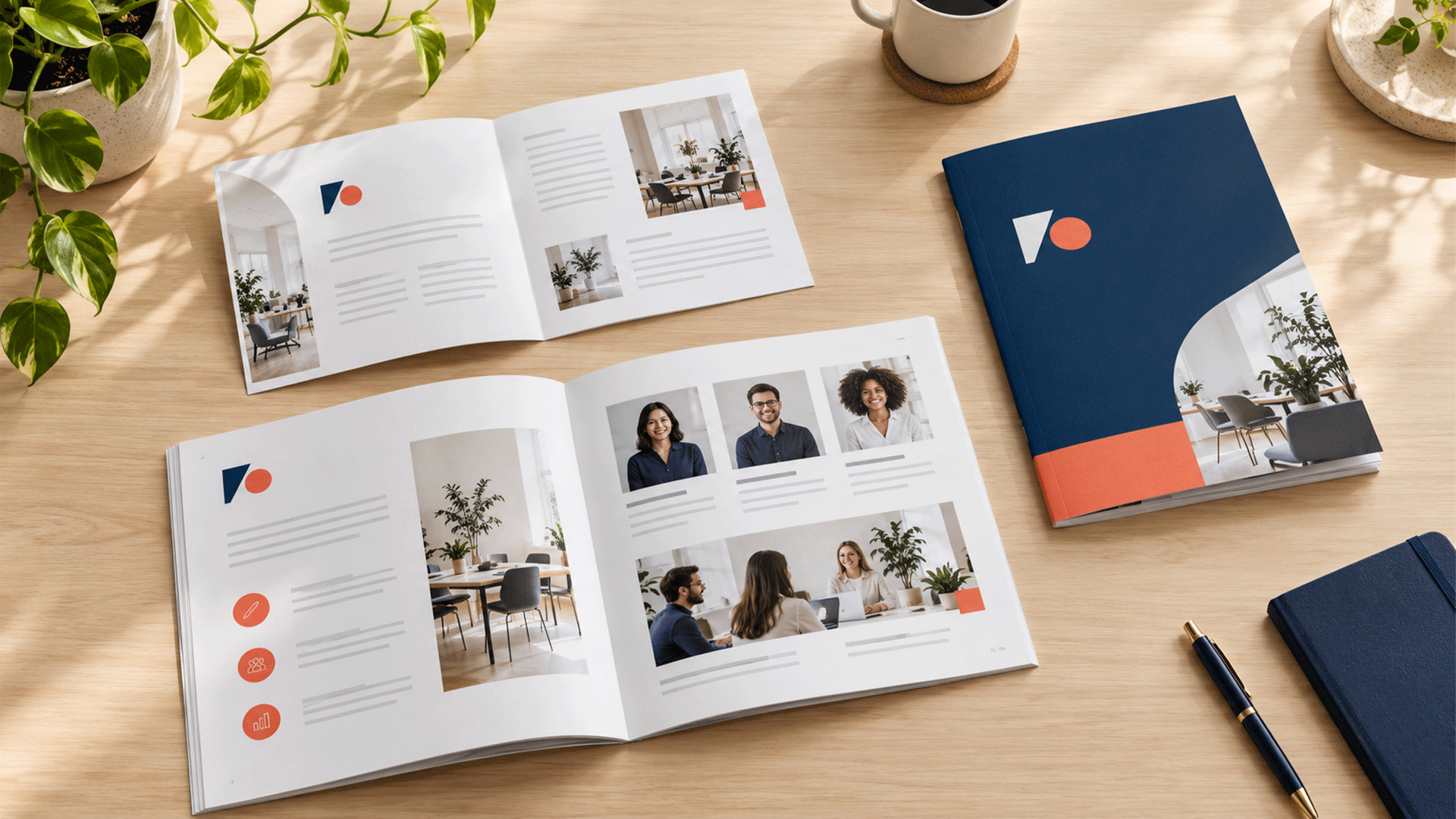
A page is one side of the finished document. A spread usually shows two facing pages.
A flat sheet printed on both sides has two pages. Folding a sheet once creates four page surfaces.
For the sample layouts below, the total includes the front cover, inside covers, and back cover.
Printing for Less’s booklet page-count guidance likewise counts the outside and inside covers as part of the finished booklet. Printing for Less
Ask your designer and printer to state the counting convention explicitly. “Eight pages including covers” is clearer than “an eight-page profile.”
Three Practical Company Profile Layouts
These examples illustrate how you could allocate content. Adjust them to your audience and available evidence.
A Four-Page Profile for a Focused Introduction
A compact profile can work when your offer is straightforward and the reader needs a useful introduction.
| Page | Suggested content |
|---|---|
| 1 | Cover with company name, business description, and relevant visual |
| 2 | Company overview and main products or services |
| 3 | Selected evidence, relevant expertise, and a brief working process |
| 4 | Useful operating details, contact information, and next step |
Keep the content selective. Page three may need a different balance depending on whether a project example, founder background, or delivery method best supports your offer.
If the text becomes cramped, edit the content or consider an eight-page version.
An Eight-Page Profile With More Supporting Detail
An eight-page plan gives individual sections more room while keeping the overall document manageable.
| Page | Suggested content |
|---|---|
| 1 | Cover and clear business description |
| 2 | Company overview and customers served |
| 3 | Main services and deliverables |
| 4 | Delivery process and working arrangements |
| 5–6 | Relevant projects, case studies, or other approved evidence |
| 7 | Team expertise, capacity, and relevant qualifications |
| 8 | Contact details and clear next step |
Use the evidence pages deliberately. Two well-explained examples may be more useful than a large gallery of unexplained images.
A business with a narrow offer may combine sections and use more room for product photography or technical capability.
A Twelve-Page Profile for a Broader Capability Review
A longer profile can be useful when the reader needs a more detailed understanding of the business.
| Page | Suggested content |
|---|---|
| 1 | Cover |
| 2 | Company snapshot and navigation |
| 3 | Customers, industries, or operating context |
| 4–5 | Main services or capability groups |
| 6 | Delivery process |
| 7–9 | Selected project evidence or detailed capability examples |
| 10 | Leadership and relevant team expertise |
| 11 | Operational capacity and relevant qualifications |
| 12 | Contact details and next step |
Every section should have enough useful material to justify its allocation.
If a section only needs a paragraph, combine it with related information. If readers need detailed product specifications, consider a separate catalogue or supporting sheet.
M4YOURS IT’s company profile design services include content structuring and branded layouts, helping businesses organize the information before finalizing the format.

How Print Production Can Affect Page Count
For a conventional folded booklet stapled through the centre, often called saddle stitching, pages are planned in multiples of four.
That makes totals such as 8, 12, 16, and 20 practical production options for that construction.
Adobe’s booklet printing guidance explains that its saddle-stitch layout requires a count divisible by four and adds blank pages when necessary. InDesign
A digital-only PDF can use a different count, such as seven or ten pages. If you later want a printed booklet, review the layout and production requirements with the printer.
Other binding and folding formats can have different requirements.
Also clarify whether a quotation lists the cover separately. A specification described as “eight inside pages plus a four-page cover” represents twelve finished page surfaces.
Confirm the total, finished size, paper, binding, and file requirements before approving the print layout.
If you need a compact folded alternative, discuss the format with your brochure design team before settling on the page plan.
Shorter Does Not Automatically Mean Easier to Read
A four-page document can be difficult to use if it contains tiny text, dense tables, and crowded images.
An eight-page version may communicate the same information more clearly through sensible spacing and a stronger hierarchy.
Nielsen Norman Group’s research on scannable writing identifies headings, lists, captions, and other structural elements that help people scan web content. Applied as a practical design principle, this supports organizing a digital profile so readers can locate relevant sections easily. NN/G
Review actual layouts before deciding the final count.
Check paragraph length, heading clarity, image size, table readability, and navigation. Test the PDF on the devices readers are likely to use.
Page count alone cannot tell you whether a document is clear.
Treat word count as a layout input. A page showing a project photograph, caption, and short explanation has different space requirements from a page describing several services.
Ask your designer to test actual text on a representative service page and case-study page. Check whether the explanation makes sense at the intended reading size.
If important detail only fits after shrinking the text, review the writing and page allocation. If a page contains very little useful information, consider combining it with a related section. This gives you a stronger basis for choosing length than a fixed word allowance for every page.
How to Shorten a Profile Without Removing Important Information
Replace Repeated Introductions With One Clear Overview
Companies sometimes explain their purpose on the opening page, repeat it in a director’s message, and repeat it again under mission and vision.
Keep the version that gives the reader the most useful information. Include additional statements only when they add something distinct.
Group Related Services
Separate pages for closely related tasks can make the offer feel fragmented.
Use a clear service group with concise descriptions and scope boundaries. Reserve dedicated pages for capabilities that genuinely need more explanation.
Select Evidence for Relevance
Choose projects that help this audience assess your business.
A profile for an industrial buyer may need different examples from one prepared for a hospitality business. You can select relevant projects without changing the underlying company facts.
Move Detailed Reference Material Into Supporting Documents
Long specifications, extensive project lists, and requested qualification documents may work better as separate materials.
Keep the main profile understandable on its own, then explain where supporting detail can be found.
Remove Decorative Filler
An attractive photograph can establish context. Several full-page images that communicate nothing about your business may simply delay the information readers need.
Use imagery intentionally and keep captions useful.
When Should You Create More Than One Version?
Different uses may justify different lengths.
For example, you could maintain:
- A one-page business snapshot for quick introductions.
- An eight-page core profile for general client discussions.
- Relevant service sheets or appendices for detailed follow-up.
Keep the source facts consistent across versions. Use the same service names, team roles, contact details, and approved evidence.
Your corporate identity design system can guide typography, colours, logo use, and layout across the documents. M4YOURS IT
Assign an owner to maintain them. A short version should remain current when the longer profile changes.
Avoid creating several editions unless each has a clear audience or distribution purpose.
An Example: Choosing a Length for Two Audiences
Consider a fictional commercial maintenance company.
For an initial introduction to an office manager, it prepares a one-page snapshot covering service coverage, main capabilities, a relevant example, and contact details.
For a supplier discussion, it uses an eight-page profile with service descriptions, working arrangements, team responsibilities, and approved project evidence.
If the buyer requests additional supporting documents, the company supplies those through the requested process.
The business uses the same verified information in each situation. The amount of detail changes with the reader’s needs.
This is a more useful basis for choosing length than matching a competitor’s page count.
What Should You Tell Your Designer?
Prepare a short brief before requesting a fixed page count.
Include:
- The intended readers and decisions the profile should support.
- Where and how the document will be shared.
- Approved content and available project evidence.
- Required languages.
- Whether printing is planned.
- Any formal page limit or submission instructions.
- Supporting documents that can remain separate.
Ask the designer to propose a content outline and sample layout first.
Agree what the quoted page count includes and how additional pages will be handled. Compare design and printing quotations using the same scope and specifications.
A proposed page count becomes easier to assess when you can see what each section will contain.
A Final Check Before Approving the Page Count
- The profile answers the intended reader’s main questions.
- The opening explains the business clearly.
- Every section has a useful purpose.
- Important claims have relevant supporting evidence.
- Repeated content and decorative filler have been removed.
- Text and tables remain comfortably readable.
- Detailed supporting material is separate where appropriate.
- Covers and blank pages are included in the agreed count.
- Print requirements have been confirmed where applicable.
- Formal submission rules have been followed.
- Someone owns updates to all versions.
FAQ
It can be. An eight-page profile can cover an overview, services, process, selected evidence, team information, and contact details. Check whether your actual content fits comfortably and answers the reader’s questions.
A new business can begin with a compact introduction. Explain its current offer, people, process, and available evidence. Expand the profile as useful information and genuine project experience become available.
In the page plans in this article, all cover surfaces count. Printers and designers may quote covers separately, so confirm whether the agreed total includes the front, back, and inside covers.
Yes, a digital-only PDF can use those counts. A conventional saddle-stitched print booklet requires a compatible total, so confirm the print construction before finalizing a version intended for both uses.
The final length depends on the text, layout, and format. Plan both languages before design begins. Separate language editions may let each audience use a more focused document.
The right company profile page count gives your audience enough relevant information in a format they can comfortably use.
Start with the content and reader’s needs, test the layout, and confirm production requirements before fixing the total.
M4YOURS IT can help you structure, design, and update a professional company profile for your intended audience and distribution format.
Share your existing content, project evidence, and intended use to discuss an appropriate page plan for your business.