

Before someone reads your latest post, watches a video, sends a message, or visits your website, they often do something much simpler: they look at your social media profile.
Within a few seconds, they begin forming an opinion.
Does this business look established? Is the brand professional? Is the information current? Does the company appear trustworthy enough to contact, follow, or buy from?
This is why social media profile design is much more than choosing an attractive profile picture and uploading a cover image. Your social profile is a digital storefront, brand introduction, credibility check, and conversion touchpoint rolled into one.
For many businesses, especially service companies, startups, ecommerce brands, consultants, agencies, and local businesses, a Facebook, Instagram, LinkedIn, YouTube, or other social profile may be one of the first branded environments a potential customer sees.
If that environment looks incomplete, inconsistent, outdated, or poorly designed, trust can disappear before the conversation even starts.
Professional social media profile design helps prevent that.
What Is Social Media Profile Design?
Social media profile design is the process of creating and organizing the visual and informational elements that represent a business across social platforms.
It commonly includes:
- Profile picture or company logo
- Cover or banner design
- Brand colours
- Typography
- Bio or company description
- Username and account naming
- Contact information
- Website links
- Calls to action
- Highlight covers
- Pinned content
- Branded post templates
- Visual consistency between platforms
The objective is not simply to make a profile attractive.
The real objective is to make your business immediately recognizable, understandable, professional, and trustworthy.
Your profile should answer three basic questions quickly:
Who are you?
What do you offer?
Why should someone trust you?
When the design and information fail to answer those questions, visitors have to work harder to understand the business. Most social media users will not spend much time doing that research.
They simply move on.
Your Social Media Profile Is Often Your First Brand Interaction
Think about how customers research businesses today.
Someone discovers a company through an advertisement.
Instead of buying immediately, they search for the brand on Instagram.
Another person receives a recommendation from a friend and searches for the company on Facebook.
A business owner receives a sales email and checks the sender’s LinkedIn company profile before responding.
A customer sees a product in a video and visits the brand’s profile to determine whether the company appears legitimate.
In every case, the social media profile becomes part of the trust-building process.
This means your profile is not separate from your website, advertising, branding, or sales strategy.
It is part of the same customer journey.
LinkedIn itself describes Company Pages as a way for businesses to become discoverable, establish credibility, interact with prospects, and showcase their organization. LinkedIn also reports that Pages with complete information receive 30% more weekly views than incomplete Pages.
That demonstrates an important principle: completeness and presentation influence how people interact with business profiles.
Why Social Media Profile Design Affects Trust
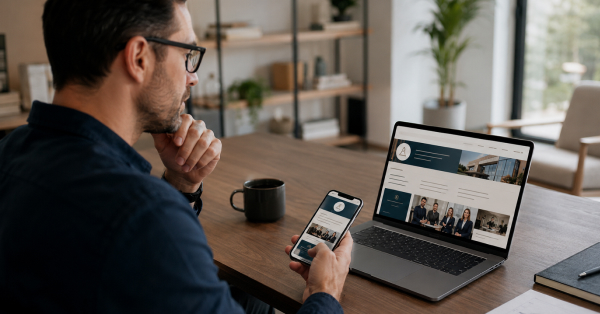
Trust online develops through multiple small signals.
People rarely decide that a company is trustworthy because of one graphic. Instead, they unconsciously evaluate many elements at once.
They notice whether the logo is professional.
They notice whether the cover design matches the website.
They notice whether the company description makes sense.
They notice whether the contact details are available.
They notice whether the latest post was published yesterday or three years ago.
They notice whether every post looks as though it belongs to a completely different company.
Individually, these details may seem minor.
Together, they create brand perception.
Visual consistency signals professionalism
Suppose your website uses a clean blue-and-white identity, while your Facebook Page uses an old red logo and your LinkedIn Page has an unrelated stock photograph.
A customer may not consciously identify the branding problem, but the experience feels inconsistent.
Consistent colours, typography, logo usage, photography, layout, and messaging make a brand easier to recognize.
That recognition gradually becomes familiarity.
And familiarity can make a business feel more established.
A structured branding system should therefore extend beyond your website or stationery into every social media touchpoint.
The Profile Picture: Small Space, Major Responsibility
Your profile image appears almost everywhere.
It can appear beside:
- Posts
- Comments
- Messages
- Search results
- Recommendations
- Notifications
- Advertisements
- Shared content
For businesses, the company logo is usually the strongest choice because it reinforces recognition.
But simply uploading your logo is not enough.
A logo designed for a horizontal website header may become unreadable when compressed into a small circular social media image.
Professional profile-picture preparation should consider:
- Simplified logo variants
- Safe margins
- Background contrast
- Small-screen readability
- Circular cropping
- High-resolution source files
Meta notes that Facebook Page profile pictures are displayed in a circular crop and recommends uploading an image at least 320 × 320 pixels for best quality.
The exact technical specifications of platforms can change, so businesses should always check current platform guidance before exporting final graphics.
The broader rule remains constant: your logo must still be recognizable when displayed very small.
Your Cover Image Should Communicate, Not Decorate
The cover or banner occupies some of the most valuable visual space on many social media profiles.
Yet businesses frequently waste it.
They upload:
- Generic stock photographs
- Random office pictures
- Oversized logos
- Outdated promotions
- Images containing too much text
- Graphics designed without considering mobile cropping
A better cover image supports the brand’s positioning.
Depending on the business, it could communicate:
- Your core service
- Your primary value proposition
- A product category
- An upcoming event
- A campaign
- Your team
- Your brand personality
- A simple call to action
The design should remain visually clean because different devices may crop portions of the banner.
LinkedIn specifically recommends keeping important cover-image details away from edges because cropping can vary across screen sizes.
Facebook similarly warns that Page cover images can be cropped and partially overlapped by the profile picture.
Designing only for desktop dimensions is therefore a common mistake.
A professional designer considers the safe visual area, not simply the canvas dimensions.
Your Bio Is Part of Profile Design Too
Profile design is not only visual.
Words influence how visitors perceive a business just as strongly as graphics.
A visitor reaching your profile should not have to guess what the company does.
Compare a vague description such as:
“Delivering excellence through innovative solutions.”
with something specific:
“Web development, branding and digital marketing solutions for growing businesses.”
The second statement communicates actual information.
An effective social media bio generally communicates:
- What the business does
- Who it serves
- What differentiates it
- Where it operates, when relevant
- What visitors should do next
Keywords may also improve discoverability on platforms that use profile information in search.
LinkedIn recommends including relevant terms and phrases in the company overview and completing important organizational information such as the website, location, industry, and company size.
Your bio should therefore be treated as part of your broader brand strategy, rather than something written quickly during account setup.
Profile Completeness Is a Trust Signal
Imagine visiting two companies’ LinkedIn profiles.
The first contains:
- Logo
- Professional banner
- Clear description
- Website
- Industry
- Location
- Current posts
- Team information
The second contains:
- Blurry logo
- No cover
- One-sentence description
- No website
- Missing company information
- Last post published two years ago
Even without knowing either company, most visitors would feel more comfortable investigating the first.
This is digital trust in action.
Completing profile information demonstrates attention to detail and gives customers more ways to verify the business.
For Facebook Pages, businesses can add information such as basic business details, addresses, operating hours, services, categories, and action buttons.
For LinkedIn Pages, companies can similarly provide organizational information, website details, descriptions, visual branding, and calls to action.
Completeness reduces uncertainty.
And reducing uncertainty is one of the foundations of online trust.
Consistency Across Platforms Matters More Than Identical Design
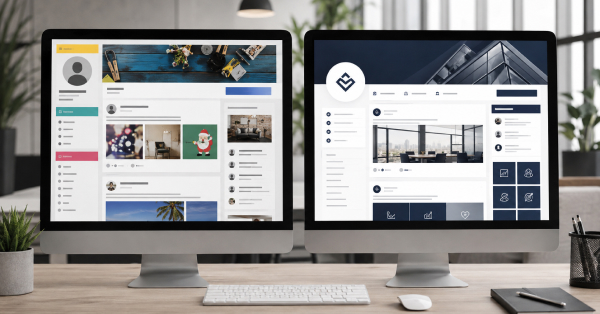
A Facebook Page and LinkedIn Page do not need to look exactly the same.
In fact, they probably should not.
Each platform has different:
- Audiences
- Content formats
- Interface structures
- Image ratios
- Communication styles
The objective is brand consistency, not pixel-for-pixel duplication.
Your LinkedIn presence might feel more corporate.
Instagram may emphasize visual storytelling.
Facebook may combine community communication, campaigns, testimonials, and announcements.
YouTube may rely heavily on thumbnails, channel banners, and video branding.
The presentation can adapt while maintaining the same underlying identity.
Core elements such as your logo, colour palette, typography, messaging style, graphic language, and brand personality should remain recognizable.
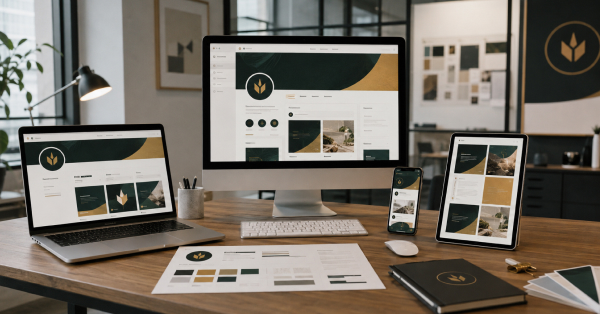
This is why a complete social media branding kit can be more useful than designing one isolated Facebook cover.
A branding kit establishes a repeatable visual system.
Your Feed Becomes Part of the Profile Design
Profile design does not stop at the profile picture and banner.
When someone opens your page, recent content often occupies most of the screen.
Your posts therefore become part of the overall brand impression.
Ask yourself:
Does the content look as though it comes from the same company?
You do not need every graphic to use exactly the same layout.
That can become repetitive.
Instead, establish a design system with recurring characteristics such as:
- Consistent colours
- Defined typography
- Image treatment
- Logo placement rules
- Illustration style
- Photography direction
- Spacing standards
- CTA treatment
- Carousel structure
These elements create recognition without making every post identical.
Professional social media design should provide enough flexibility for different campaigns while maintaining an identifiable visual language.
Pinned Content Can Strengthen Your First Impression
Businesses often concentrate heavily on publishing new posts while ignoring what a first-time visitor actually sees.
Pinned or featured content can intentionally shape that experience.
Depending on the platform and available features, consider highlighting:
- Company introduction
- Main services
- Best-selling products
- Client success story
- Testimonials
- Current promotion
- Important announcement
- Portfolio showcase
- Frequently asked questions
Think of these assets like important sections of a homepage.
They should help new visitors move from discovery toward understanding and action.
Social Proof Should Be Visible
A beautifully designed profile cannot manufacture credibility by itself.
Real trust depends on evidence.
That is why good social media profile strategy integrates authentic trust signals wherever appropriate.
Examples include:
- Customer reviews
- Testimonials
- Case studies
- Client work
- Team photographs
- Business achievements
- Partnerships
- Certifications, where legitimate
- Behind-the-scenes content
- User-generated content
Avoid overwhelming the profile with badges and claims.
Trust signals work best when they feel natural and verifiable.
The objective is not to repeatedly tell visitors that your company is trustworthy.
Give them enough evidence to reach that conclusion themselves.
Profile Design Should Support Conversion
A social profile should not become a visual dead end.
Once a visitor trusts your business, what should happen next?
Maybe you want them to:
- Visit your website
- Request a quotation
- Book a consultation
- Message your team
- View your products
- Download something
- Register for an event
- Follow your account
The profile should make that next action obvious.
Your cover message, bio, link, button, featured content, and recent posts should work together.
This is where branding and digital marketing intersect.
Design attracts attention and establishes perception.
Marketing directs that attention toward meaningful action.
Common Social Media Profile Design Mistakes
Several mistakes repeatedly damage otherwise good business profiles.
Using low-quality logos
Pixelated graphics immediately reduce visual professionalism.
Always maintain proper vector or high-resolution logo files.
Using different logos everywhere
Old logos, different colours, and unauthorized logo variations fragment brand recognition.
Overloading the cover design
Your banner does not need to explain your entire company.
Communicate one clear idea.
Ignoring mobile cropping
A design may look perfect on a designer’s desktop and fail completely on a smartphone.
Always test across screen sizes.
Leaving important profile fields empty
Missing descriptions, websites, locations, or contact information creates unnecessary friction.
Using outdated information
Old phone numbers, former addresses, expired promotions, and discontinued services are particularly damaging because they suggest the profile is unmanaged.
Having no visual system for posts
Random templates and inconsistent design styles make the brand difficult to recognize.
Copying competitors too closely
Your profile should establish your own visual identity rather than becoming another version of the category leader.
Focusing only on appearance
Professional graphics cannot compensate for unclear messaging, unanswered messages, misleading information, or weak customer service.
Design should support a trustworthy business experience—not disguise problems.
A Practical Social Media Profile Design Checklist
Before considering your social profile complete, review the following:
Brand identity
- Correct logo
- Consistent brand colours
- Defined typography
- Recognizable visual style
Profile graphics
- High-quality profile picture
- Platform-specific cover image
- Mobile-safe composition
- Correct image cropping
Business information
- Accurate business name
- Clear description
- Current website
- Correct contact information
- Location where relevant
- Business hours where relevant
Conversion
- Clear CTA
- Working website link
- Correct message or booking options
- Relevant pinned content
Content
- Consistent branded posts
- Current information
- Useful recent content
- Authentic social proof
Quality control
- No spelling mistakes
- No stretched graphics
- No expired promotions
- No obsolete logo variations
- No broken links
Review this checklist periodically rather than treating profile setup as a one-time project.
When Should You Redesign Your Social Media Profile?
A redesign is worth considering when:
- Your company has rebranded
- Your logo has changed
- Your services have changed
- The current profile looks outdated
- Each social platform uses different branding
- Your business is expanding into new markets
- You are launching a major campaign
- Profile engagement is weak
- Customers struggle to understand what you offer
- Your social presence no longer matches your website
You may not need a complete rebrand.
Sometimes the problem is simply poor implementation of an otherwise strong identity.
A structured audit can determine whether you need new branding, refreshed profile graphics, updated templates, or a complete social media visual system.
Professional Social Media Profile Design Is an Investment in Credibility
Businesses invest heavily in websites, advertisements, SEO, video, and sales campaigns.
But those campaigns regularly send prospects back to social media profiles.
If those profiles look unfinished, an important link in the customer journey becomes weaker.
Strong social media profile design creates continuity.
A prospect can move from an advertisement to your profile, from your profile to your website, and from your website to a conversation without feeling as though they encountered three different companies.
That continuity supports recognition.
Recognition supports familiarity.
Familiarity helps establish trust.
And trust makes taking the next step easier.
Build a Social Media Presence That Looks as Professional as Your Business
Your social media profile may receive only a few seconds to make its first impression.
Make those seconds count.
M4YOURS IT helps businesses develop professional branding, social media visual systems, profile graphics, branded content templates, and digital marketing experiences that maintain consistency across customer touchpoints.
Whether you are launching a new brand, refreshing an outdated social presence, or standardizing multiple business profiles, a structured social media branding system can help your company communicate with greater clarity and credibility.
Want to improve how your business looks across social media?
Contact M4YOURS IT to discuss a professional social media profile design and branding solution tailored to your business.
Frequently Asked Questions
Social media profile design can include profile images, cover banners, bios, branded highlight covers, visual guidelines, calls to action, profile optimization, and platform-specific branded assets.
It helps businesses create a credible and consistent first impression while making their brand easier to recognize across different social platforms.
Use the same brand identity, but adapt layouts for each platform. Facebook, LinkedIn, Instagram, YouTube, and other channels have different formats and audiences.
For most business accounts, yes. A recognizable logo generally makes it easier for people to identify the company across feeds, comments, messages, and searches.
Update them whenever your branding, services, campaigns, contact information, positioning, or major business priorities change. Profiles should also be reviewed periodically for outdated information.
It can communicate your core service, positioning, campaign, product category, team, event, or another important brand message. Keep the composition simple and mobile-friendly.
Yes. Consistent professional branding improves recognition and creates a stronger environment for social media content, advertising, lead generation, and customer communication.
A social media branding kit is a collection of standardized visual assets and guidelines such as profile graphics, post templates, story layouts, colours, typography, and design rules.
Yes. Existing business profiles can be audited and updated without creating completely new accounts. Logos, banners, descriptions, featured content, and visual systems can all be improved.
Yes. M4YOURS IT provides branding, creative design, social media branding kit, and digital marketing services for businesses that want a professional and consistent digital presence.

