

You want your business to look more professional. One proposal offers logo design. Another includes corporate identity. A third describes a complete branding package.
The terms overlap, but the work can be very different.
You might need a clearer business message, a better identifying mark, or practical templates that make everyday communication consistent. Choosing a service begins with identifying that need.
Logo design develops an identifying mark. Corporate identity design builds a coordinated visual system. Branding involves the wider decisions and ongoing work that shape how a business is identified, understood, and experienced.
Your business may need one focused project or a combination. It may also be able to keep valuable existing assets.
This guide explains the differences and provides a practical way to decide where to begin.
The Difference at a Glance
For this comparison, corporate identity design means the visual system used across a company’s communications.
Providers may use “brand identity” for similar work, so always check the deliverables.
| Service | Main focus | Possible outputs | Useful starting point when… |
|---|---|---|---|
| Logo design | An identifying mark | Logo arrangements, colour versions, artwork, usage guidance | The business direction is clear, but the logo needs development or improvement |
| Corporate identity design | Consistent visual expression | Colour and typography systems, layouts, stationery, templates, guidelines | The materials look disconnected or employees lack usable standards |
| Branding | Brand direction and its expression over time | Research, positioning, messaging, identity, implementation priorities | The audience, offer, intended perception, or business direction needs clarification |
These are working distinctions, not fixed package specifications. A branding engagement might include identity and logo development, while a focused identity project may include a discovery stage.
Ask what the provider will investigate, decide, create, and help implement.
What Is Logo Design?
Logo design develops the visual mark used to identify your business.
It may involve a wordmark, symbol, monogram, or combination, depending on the brief.
A logo project commonly considers:
- The business name and required languages.
- The intended audience and presentation.
- Relevant competitors and similarity concerns.
- Readability in priority applications.
- Appropriate arrangements and colour versions.
- Final artwork and basic usage instructions.
The work still needs business context. Even a focused logo project should establish what the mark needs to support.
Consider a company whose existing name becomes difficult to read in a mobile header. If the underlying direction remains appropriate, the immediate need may be a revised arrangement or lettering.
A different company may need a new mark because its current artwork cannot support the agreed requirements.
Choose a focused logo project when you can explain the business direction and identify a problem with the mark itself.
Confirm the actual scope of professional logo design, including versions, application checks, revisions, and final files.
What Is Corporate Identity Design?
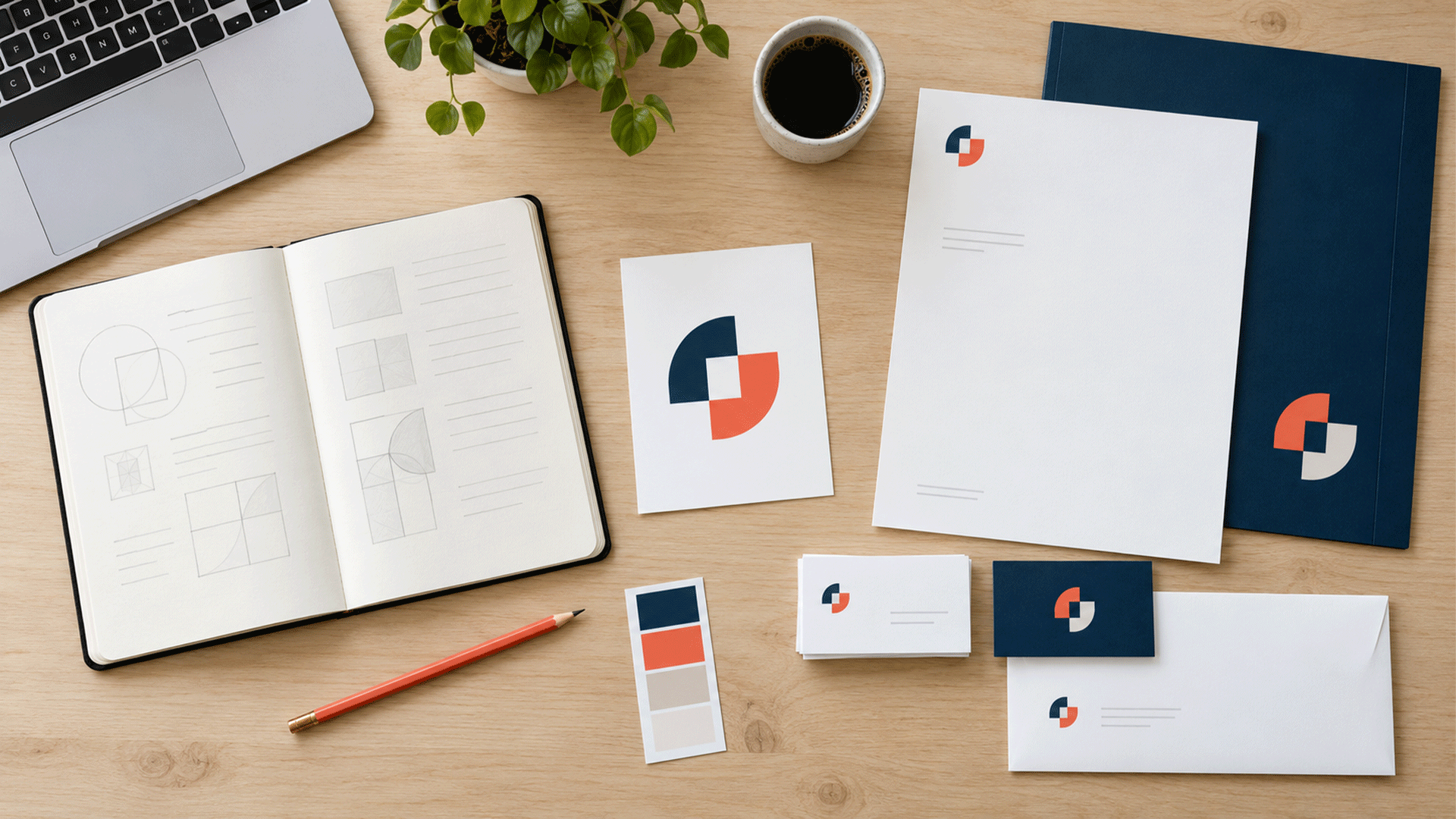
Corporate identity design establishes how the company’s visual elements work together across business communication.
It extends beyond the logo into a repeatable system.
Possible components include:
| Component | What it helps the team do |
|---|---|
| Colour system | Use colours consistently and understand their roles |
| Typography | Format headings, body text, tables, and supporting information |
| Layout principles | Arrange content with consistent spacing and structure |
| Supporting graphics | Use imagery, shapes, icons, or patterns coherently |
| Stationery | Present everyday correspondence consistently |
| Document templates | Prepare proposals, reports, and other recurring materials |
| Presentation layouts | Create slides within an agreed visual approach |
| Guidelines | Make routine design decisions without guessing |
An existing logo can remain part of this system.
For example, a consultancy might have a suitable mark but several unrelated proposal styles. Its immediate need may be working templates and clear standards.
A real example of documented application is the Mastercard Foundation’s brand guidelines, which address brand marks alongside language, photography, colours, and typography. This illustrates how guidance can extend beyond a logo file. mastercardfdn.org
Consider corporate identity design when the business direction is sufficiently clear, but the visual materials and everyday tools need coordination.
What Is Branding?
Branding is the broader work of establishing and managing how a business presents itself and the associations it aims to build.
It can involve strategic choices, communication, visual identity, and the experience the organization delivers.
The American Marketing Association’s branding overview distinguishes identifying brand features, visual identity, positioning, and corporate branding. Its description of corporate branding includes organizational identity, values, culture, and public perception. American Marketing Association
A branding engagement might investigate:
- Which audience the business should prioritize.
- What customers need and how they choose.
- How the offer differs from relevant alternatives.
- What the business can credibly promise.
- How its value should be explained.
- What visual and verbal direction supports those choices.
- Which customer interactions need attention.
Brand strategy provides direction for this work. Branding also involves applying and maintaining that direction.
A strategy document cannot by itself ensure that sales conversations, service delivery, and customer support reflect the intended promise.
Consider broader branding work when the business needs clarity about its audience, offer, positioning, or intended presentation.
Agree on the depth of the brand strategy and foundation work before commissioning the visual outputs.
How the Three Services Work Together
Imagine a fictional IT support company moving from occasional repairs toward ongoing support for small offices.
The work could involve:
- Clarifying the priority audience and ongoing support offer.
- Developing messaging that explains that offer.
- Assessing whether the existing logo remains suitable.
- Establishing visual rules for proposals, presentations, and the website.
- Updating the relevant materials and briefing the team.
The logo might change, be refined, or remain.
The key is to make that decision in context. Buying three separately named packages is not automatically necessary, and buying a larger package does not resolve unclear responsibilities.
A coordinated project should explain the relationship between strategy, visual development, and implementation.

Start With the Problem You Can Observe
Describe what is happening before choosing a service.
“We need better branding” is a useful conversation starter. A specific observation gives the team more to investigate.
| Observation | What to investigate | Possible starting scope |
|---|---|---|
| Customers misunderstand what we provide | Offer, message, and buying context | Discovery and messaging |
| The business name is hard to read in key applications | Logo artwork, arrangement, and available space | Focused logo development |
| Every proposal looks different | Standards, templates, and team workflow | Corporate identity and document templates |
| A new offer targets a different audience | Positioning, naming relationships, and communication | Brand strategy and application planning |
| A suitable identity exists, but enquiries are low | Reach, content, website journey, offer, and follow-up | Marketing or customer journey review |
| Employees cannot find or use approved assets | File organization, access, guidance, and training | Identity implementation and handover |
These are starting hypotheses. A review may reveal several connected issues.
Separate what you have observed from what you assume is causing it.
Five Questions to Ask Before Choosing
1. Can we clearly explain who we serve?
Identify the priority customers and the circumstances in which they buy.
If the team gives conflicting answers, establish that direction before using personal taste to settle visual decisions.
2. Can we explain our offer and relevant value?
Write a plain-language explanation of what you provide and why a customer might choose it.
Support the explanation with the actual business offer and capabilities.
3. Is the logo causing a specific problem?
Describe the application and issue. Gather examples of readability difficulties, unsuitable arrangements, or relevant similarity concerns.
An internal feeling that the mark is “old” needs further explanation.
4. Are our materials consistent and practical?
Review the website, proposal, invoice, presentation, and social communication together.
Then ask employees to use the existing templates. Visual inconsistency and editing difficulties may reveal different needs.
5. Has the business changed?
Consider changes to the audience, offer, structure, markets, or required languages.
A meaningful change may justify reviewing earlier decisions. It does not automatically establish that every asset needs replacing.
What Does a New Small Business Need?
A new business needs enough clarity and practical design support to launch coherently.
The depth depends on what is already known and what the launch requires.
A focused initial scope might include:
- A discovery discussion and agreed brief.
- A clear description of the audience and offer.
- An appropriate logo system.
- Basic colour and typography rules.
- The few templates needed for immediate communication.
- Organized files and usage guidance.
For an online consultancy, proposals and presentation layouts may matter more initially than printed folders.
For a local product business, labels, packaging information, and retailer materials may be priorities.
Record important uncertainties. Where positioning or naming remains unresolved, investigate those questions before finalizing dependent artwork.
The aim is a usable starting system with a clear plan for what follows.

focus on those operational needs.
Where growth involves a changed market position, investigate the strategic implications as well.
The scope should follow the actual change, rather than assume that growth requires a new logo.
What If Your Business Is Repositioning?
Repositioning concerns how the business intends to compete and be understood.
That can affect the message, evidence, identity, and customer experience.
Before redesigning, clarify:
- What is changing and why.
- Which customers are now the priority.
- What remains valuable from the existing business.
- What evidence supports the intended promise.
- Which communications or experiences need updating.
Then assess the visual implications.
A company moving into a specialist service may need clearer messaging and stronger case studies alongside identity changes. A new logo alone cannot provide the missing evidence.
Record which assets should be preserved and which no longer fit the agreed direction.
Three Illustrative Business Scenarios
The following examples describe possible project scopes, not measured client results.
Scenario 1: The Offer Is Clear, but the Logo Is Difficult to Use
A local service company understands its audience and uses consistent messaging.
Its logo becomes unreadable in small digital applications, and the team lacks approved alternatives.
A useful starting scope could be a focused logo review, appropriate refinements or development, application checks, and organized artwork.
Keep the existing strategy and suitable materials unless the review identifies a reason to change them.
Scenario 2: The Logo Works, but the Materials Look Unrelated
A consultancy has a usable logo and a clear offer.
Its employees create proposals, reports, and slides independently, producing inconsistent typography and layouts.
A useful scope could retain the logo while establishing a visual system, working templates, guidelines, and a handover session.
The main task is giving the team dependable tools for recurring communication.
Scenario 3: The Business Direction Is Unclear
A company describes itself as a retailer, wholesaler, and premium specialist, without agreeing on its priority audience or offer.
The team requests a “more premium” logo.
A useful starting point is discovery and positioning. Once the direction is agreed, the team can determine the messaging, identity, and logo work required.
How to Prioritize When the Budget Is Limited
Choose a scope that addresses the most important confirmed problem.
A practical sequence is:
- Clarify: Resolve the decisions that other work depends on.
- Assess: Review existing assets and identify what can stay.
- Create: Develop the necessary identity elements and priority templates.
- Apply: Update the agreed channels and materials.
- Maintain: Keep files, guidance, and responsibilities current.
Stages can overlap or form one engagement.
Include implementation in the discussion. A proposal for design may not include website updates, printing, translation, staff training, or replacing existing materials.
A phased scope should leave each completed stage useful. Define what the business can use immediately and what remains for later.
Compare Proposals by Deliverables and Responsibilities
Package names do not provide enough detail for a reliable comparison.
Ask each provider to specify:
| Question | What the answer should clarify |
|---|---|
| What problem are we addressing? | The purpose of the work |
| What discovery is included? | Research, interviews, workshops, or review |
| Which decisions will be documented? | Audience, positioning, messaging, or visual direction |
| What will be designed? | Named assets, quantities, and versions |
| What can we edit? | Formats, software, access, and dependencies |
| How will concepts be assessed? | Criteria, reviewers, and approval responsibility |
| What will be implemented? | Actual channel updates and production responsibilities |
| What happens at handover? | Files, guidelines, walkthroughs, and support |
If a proposal describes a branding package but includes only a logo and stationery, discuss the gap between the label and your expectations.
The package may still suit a focused need. What matters is that the agreed scope matches the business problem.
How Will You Know the Project Is Useful?
Set review criteria before approving the work.
For a logo project, check the agreed identification, readability, and application requirements.
For corporate identity, ask someone from the team to prepare a real proposal or presentation using the delivered system.
For strategy work, check whether the team can explain the agreed audience, offer, positioning, and communication priorities consistently.
Track operational outcomes such as asset availability, template use, and completion of planned updates.
Sales and enquiry changes need broader interpretation because marketing activity, pricing, demand, service delivery, and other factors can change at the same time.
FAQ
Logo design is one part of a brand’s visual expression. Branding can also involve positioning, messaging, communication, implementation, and the experience the business delivers.
Yes. A project can retain an appropriate logo while improving typography, colour use, layouts, templates, and guidelines.
The required depth varies. Some businesses need focused discovery and a practical identity system; others need deeper research and strategic decisions.
No. Relevant discovery can be included in a combined engagement. Confirm its depth and outputs rather than assuming every project needs separately purchased stages.
A new logo cannot establish the cause of low sales. Review the audience, offer, reach, buying journey, and delivery alongside any evidence of a design problem.
Start with the issue your business needs to resolve and the materials your team needs to use.
M4YOURS IT offers brand strategy and foundation, logo design, and corporate identity design services. Discuss the relationship between those areas and agree on the specific work your project requires. M4YOURS IT
Bring your current logo, business materials, goals, and concerns to M4YOURS IT to define a practical next step for your brand.