Share



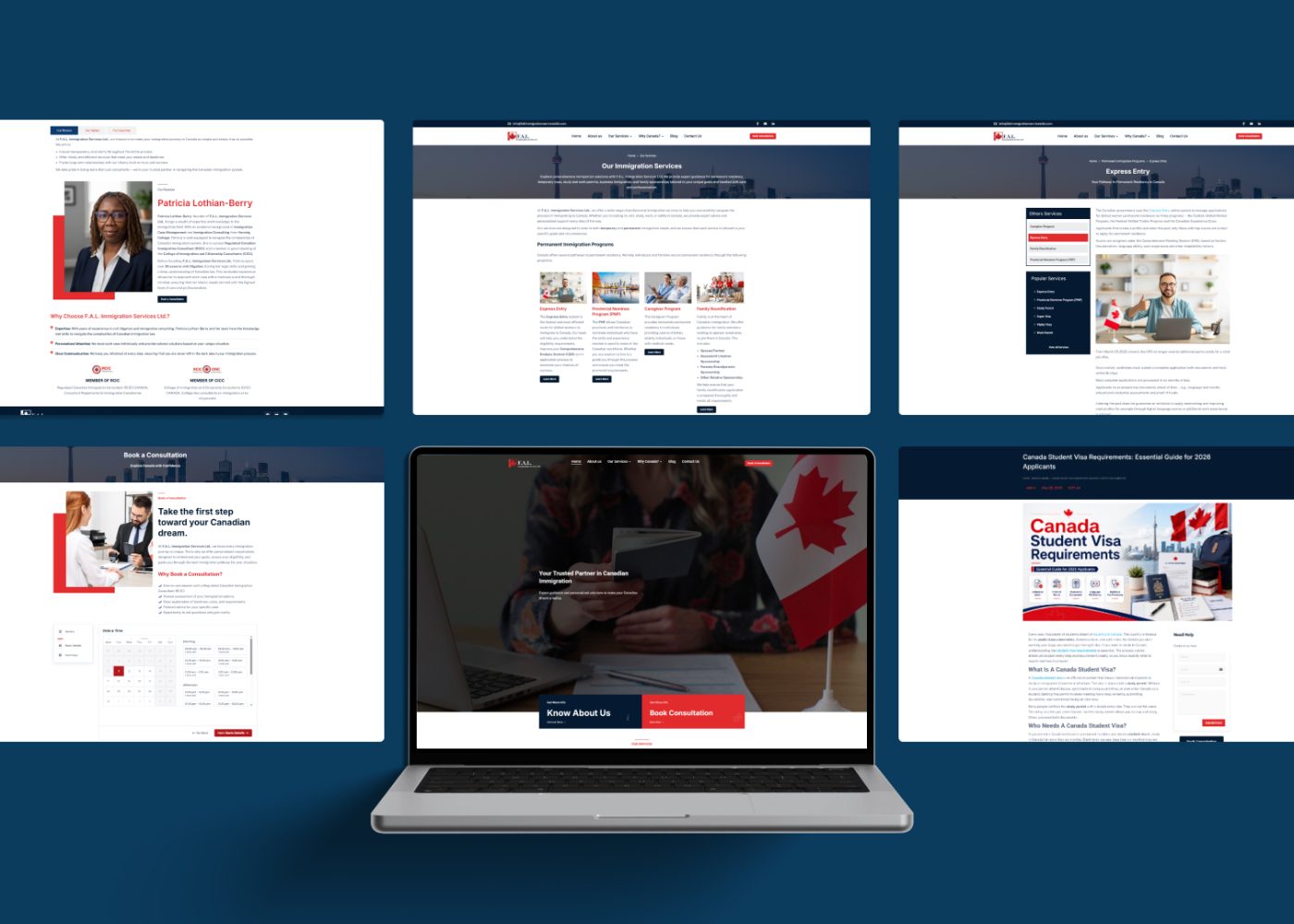

















Start by giving each page a clear purpose. Keep pages that serve different needs, rewrite pages with unclear roles, and combine pages that genuinely repeat the same job. When retiring a URL, choose the appropriate technical treatment and update the links that lead to it.
A service page explaining your professional help and a blog answering a preparation question can both be useful. Two pages promoting essentially the same service to the same audience may need consolidation.
For your immigration firm website and marketing, the goal is a clearer path from search to useful information and a suitable consultation.
Several pages mentioning “work permits” or “family sponsorship” do not automatically create a problem.
Look for overlap in purpose, audience, main answers, and next steps. Ask whether a visitor can understand why both pages exist.
Common warning signs include:
SEO teams sometimes describe problematic overlap as keyword cannibalization. Use that term as a prompt to investigate, rather than a diagnosis based on shared words.
Google says duplicate content is generally not a violation of its spam policies. Avoid assuming that ordinary duplication has triggered an automatic penalty. developers.google.com
Create one record for each relevant service page, blog post, and supporting guide. Start with a priority service rather than reorganizing the whole website at once.
| Record | Why it matters |
|---|---|
| URL, title, and page type | Identifies the exact page and its intended role. |
| Audience and main question | Helps distinguish genuinely different needs. |
| Main service and next action | Connects content with the firm’s operations. |
| Search performance and known enquiries | Preserves evidence of existing value. |
| Internal links, external links, and technical status | Reveals dependencies before a URL changes. |
| Content owner and review date | Shows who can approve updates. |
Include pages outside the main navigation. Old campaign pages, downloaded guides, and forgotten articles may still receive visits or links.
Save the existing copy and record a performance baseline before implementation. Keep a decision log showing the proposed action and destination for each changed URL.
A marketing strategy consultation can help prioritize the service groups that matter most to the practice.
Use the Search Console Performance report to examine queries, landing pages, clicks, impressions, and click-through rate. Compare consistent date ranges and relevant audience segments. Search Console Help
For a suspected overlap:
Two URLs appearing for similar queries is a reason to review them, not proof that one must disappear.
Search Console also has reporting limits. Some queries are omitted, and most duplicate-page performance data is credited to the canonical URL. A page showing little data may therefore need further investigation. Search Console Help
Read the pages themselves. A numerical report cannot explain whether one page contains valuable preparation advice missing from another.
Use the page’s purpose and evidence to select an action.
| Situation | Recommended action |
|---|---|
| Same broad topic, different useful questions | Keep both and clarify their roles. |
| Useful content, but an unclear audience or promise | Rewrite the page around a distinct need. |
| Same audience, purpose, and substantially repeated answers | Combine the useful material into one suitable destination. |
| Duplicate versions that must remain accessible | Review canonicalization. |
| Obsolete content with a genuinely relevant replacement | Retire the old URL with an appropriate redirect. |
| Content being removed with no suitable replacement | Consider a proper removal response rather than an unrelated redirect. |
Do not choose purely by word count, publication date, or which URL looks shortest.
A broad service overview and a detailed subservice page may deserve separate roles. Likewise, a useful historical announcement may need a clear archive label rather than being rewritten as evergreen advice.
Have the responsible RCIC review immigration information before approving the editorial decision.
A service page should help someone understand the firm’s professional assistance and decide whether to enquire.
A supporting article should answer a defined question or help the reader prepare.
The following titles are hypothetical examples, not an audit of an actual firm:
| Page | Clear role |
|---|---|
| Spousal Sponsorship Services | Explain actual service scope, professional identity, process, and consultation options. |
| What to Prepare for a Spousal Sponsorship Consultation | Provide approved preparation guidance and link to the relevant service. |
| Questions to Ask Before Hiring an Immigration Consultant | Help readers evaluate professional help. |
| Help With Spousal Sponsorship | Review for consolidation if it merely repeats the first service page. |
Changing a title alone will not create a meaningful distinction. Revise the opening, main answers, examples, and next step to support the page’s specific purpose.
Your website design should make those relationships easy to follow. A reader should be able to move from a practical guide to the relevant service without encountering another nearly identical overview.
When two pages genuinely do the same job, choose a destination that suits the audience and can support the combined content.
Review the existing URL’s relevance, useful search visibility, known enquiries, links, and place in the site structure. Retaining a suitable established URL may avoid an unnecessary move.
Then build a fresh outline:
Avoid simply pasting two articles together. The combined page should read as one coherent resource.
Record what moved, what was removed, and who reviewed it. Check that any appointment links, forms, and downloadable resources still make sense in the new context.
These tools address different situations. Choose the editorial outcome first, then implement the appropriate technical change.
For duplicate or very similar content accessible at different URLs, a canonical annotation can identify the preferred version. Google treats it as a signal and makes the final selection.
It does not redirect visitors. Do not point every related blog post to a service page merely because they share a topic.
Google’s canonical URL guidance also discourages using robots.txt or noindex as methods for choosing a canonical page. developers.google.com
If an old page is permanently replaced by a relevant consolidated page, use an appropriate permanent server-side redirect where possible. Google’s redirect guidance identifies HTTP 301 and 308 as permanent redirects. developers.google.com
Map the old URL directly to the relevant final destination. Google warns against sending many old pages to an irrelevant homepage, which may be treated as a soft 404. developers.google.com
If a page is genuinely removed and has no suitable replacement, a proper 404 or 410 response may be appropriate. Do not manufacture an unrelated destination just to avoid a missing-page response. developers.google.com
Ask the developer to document and test the chosen behaviour.
After consolidation, update links in navigation, service pages, blog posts, resource lists, and booking journeys.
Point visitors directly to the intended destination instead of relying on avoidable redirects.
Keep internal links, sitemap entries, and canonical signals consistent with the preferred URLs. Google recommends linking internally to canonical URLs and avoiding conflicting canonicalization signals. developers.google.com
Review other places the old address appears, including email templates, social profiles, and active campaigns.
Assign one content owner for each topic group. Their responsibility should include reviewing future briefs against existing pages, not simply approving new articles.
Test the affected URLs and consultation journey after launch:
Use URL Inspection to examine Google’s indexed information. The indexed report can show Google’s selected canonical; the live test cannot predict that selection. Search Console Help
Record the implementation date and compare performance across the entire affected topic group. An old URL losing visits after replacement is not, by itself, evidence that the project failed.
Review whether the intended pages attract relevant queries and whether visitors reach useful information and consultation options.
Connect approved CRM and marketing automation with completed enquiries and confirmed bookings where attribution is available. Do not judge success using page traffic alone.
Search visibility can fluctuate while Google processes URL changes. Review the technical setup promptly when something breaks, while allowing for reprocessing and normal variation. developers.google.com
Before commissioning another article, add these fields to the brief:
If the proposed article cannot explain its distinct value, improve an existing page instead.
Maintain a simple topic map and review it when the firm changes services or commissions a new content batch. This makes the next publishing decision easier.
Your next project
Have a business in mind? Tell us about your ideas, your audience, and the identity you want to create.
Prefer a direct conversation?
No. Different pages can legitimately discuss the same topic. Review whether they answer different questions, serve distinct audiences, and offer clear next steps before deciding that the overlap needs fixing.
Google says duplicate content is generally not a violation of its spam policies. Ordinary duplication still deserves review when it confuses visitors or creates unnecessary URL versions.
A useful service page can address several related searches. Group phrases around a coherent audience and purpose instead of creating a separate page for every wording variation.
Keep a blog when it answers a distinct, useful question. Merge only where the content genuinely repeats the same job and a consolidated destination will serve the reader well.
Review relevance, content quality, links, useful search visibility, enquiry value, and site structure. Prefer a suitable existing destination where practical. There is no universal rule that the oldest or highest-traffic URL must win.
No. A canonical annotation signals a preferred version of duplicate or very similar content. A redirect sends the visitor to another URL. Choose according to whether both versions need to remain accessible.
Only if the underlying purpose and content also become clearer. Two pages with new titles but almost identical answers may still leave visitors uncertain about which one they need.
Genuine translations serve different language audiences. Google does not treat fully translated main content as ordinary same-language duplication. Review multilingual implementation separately rather than automatically redirecting translations to English. developers.google.com
There is no guaranteed improvement or universal timeline. Google needs to process changes, and results depend on content, technical implementation, competition, and demand. Monitor the whole topic and consultation journey.
Review accuracy and usefulness first. Some articles need updating, some deserve clear historical context, and some may be consolidated or removed. Age alone is not enough to select an action.
Start with one priority topic, document the evidence, and agree on each page’s role before changing URLs. Preserve useful information, implement the technical decision carefully, and review the resulting consultation journey.
M4YOURS IT can connect digital marketing, content planning, website improvements, and enquiry tracking.
Contact M4YOURS IT to plan an immigration content audit around your firm’s services and growth priorities.
Adding {{itemName}} to cart
Added {{itemName}} to cart